.png "The Vested Group | NetSuite Solution Provider Partner | NetSuite Consulting | NetSuite Support")
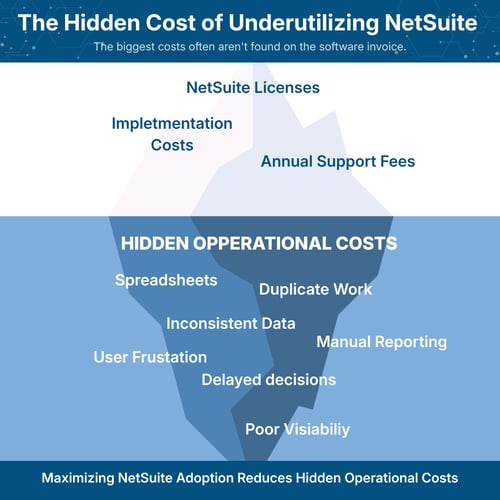
NetSuite underutilization is not a system failure — it is the gap between what the platform can do and what the organization has configured it to do. Most companies that implemented NetSuite and never invested in structured post-go-live optimization are leaving measurable value on the table: in labor hours spent on manual processes, in reporting that requires spreadsheet assembly, and in decisions delayed by data that is not current or accessible. The hidden cost of underutilization is real, quantifiable, and addressable through managed services and ongoing optimization.
Most organizations that implement NetSuite do so with a clear goal: streamline operations, consolidate data, and gain real-time visibility across the business. But a significant number of those same organizations reach the one-year or two-year mark after go-live and quietly realize that something is off. The system is running. Invoices are processing. Payroll is flowing. Yet the business still feels like it is operating the same way it always did — with spreadsheets filling the gaps, manual processes absorbing hours each week, and leadership making decisions based on data that is never quite current enough.
This is what NetSuite underutilization looks like. It is not a dramatic system failure. It is a slow, compounding erosion of the value the platform was purchased to deliver. And for most businesses, the financial impact is far greater than they recognize.
What Underutilization Actually Looks Like
NetSuite underutilization does not announce itself. It accumulates gradually, often masked by the appearance of progress. The system is live. Licenses are paid. Users log in. But underneath that surface-level activity, the organization is leaving substantial capability, and ROI, on the table.
Signs of underutilization include teams that export NetSuite data into Excel before they can analyze it, approval workflows that still run through email chains rather than through the system, reports that require manual consolidation every month, and integrations that were scoped during implementation but never completed. It also shows up in user behavior: employees who use the system for basic transaction entry but turn to offline tools for everything else.
In many organizations, underutilization is not a technology problem, it is a configuration, training, and adoption problem. The platform has the capability. The organization simply has not unlocked it.
The Spreadsheet Problem
The most visible symptom of NetSuite underutilization is persistent spreadsheet dependency. When a business invests in a modern ERP, the expectation is that spreadsheets will become supplementary tools rather than core operational infrastructure. When that shift does not happen, it is a signal that the system is not configured to support the workflows users actually need.
Spreadsheets introduce risk. They break. They get emailed to the wrong people. They contain formula errors that go undetected for months. They exist outside the audit trail. They create version control problems that consume hours of reconciliation time. When a finance team of five people each maintains their own version of the same report, the organization is not just working inefficiently — it is building a foundation for costly errors.
More importantly, spreadsheet dependency means that the business intelligence the organization paid for is not being generated. NetSuite can consolidate and surface data in real time. If that data is being pulled into spreadsheets and processed manually, the organization is duplicating effort and degrading the quality of its information simultaneously.
The Operational Cost of Manual Processes
Every manual process that survives after a NetSuite implementation represents a cost. It is a cost in labor hours, in error rate, and in the opportunity cost of staff time that could be directed toward higher-value work.
Consider a simple example: a company that manually matches purchase orders to vendor invoices rather than using NetSuite's three-way match automation. A single accounts payable specialist processing 200 invoices per month might spend 90 minutes per day on this task. Over a year, that is approximately 390 hours — the equivalent of nearly 10 full work weeks — dedicated to a process that NetSuite can automate almost entirely.
Multiply this across every manual process in the organization — revenue recognition adjustments, intercompany eliminations, bank reconciliation, expense report routing, order status updates — and the aggregate labor cost becomes substantial. For mid-market companies, total manual processing time that could be automated through proper NetSuite configuration often exceeds 2,000 to 4,000 hours annually across the finance and operations teams.
At an average fully loaded labor cost of $75 per hour, that represents $150,000 to $300,000 in direct operational expense that could be eliminated or dramatically reduced through platform optimization.
Leadership Visibility Is Suffering
One of the primary reasons organizations invest in ERP systems is to give leadership real-time visibility into business performance. When NetSuite is underutilized, that visibility degrades — not because the data does not exist, but because it is not organized, surfaced, or accessible in a way that supports fast decision-making.
Leadership teams in underutilized NetSuite environments often rely on monthly financial packages that take the finance team several days to prepare. KPIs are tracked in dashboards that require manual updates. Operational questions — current backlog, open purchase orders, days sales outstanding — require someone to pull a report rather than simply checking a dashboard.
This delays decisions. In fast-moving business environments, a week's delay in understanding cash position, pipeline coverage, or inventory levels translates directly into slower responses to market conditions. Organizations that have fully optimized their NetSuite environment can answer these questions in seconds. Organizations with underutilized implementations often cannot answer them at all without a manual effort.
User Adoption Declines Over Time
User adoption is not a fixed state. It declines when the system does not meet user needs, when workflows are confusing, or when the system creates friction rather than reducing it. In underutilized NetSuite environments, this pattern is common.
Users who find that completing a task in NetSuite takes longer than doing it outside the system will consistently choose the path of least resistance. Over time, this creates a shadow infrastructure of spreadsheets, email chains, and workarounds that runs parallel to the official system. Adoption numbers may show that users are logging in, but the system is not capturing the business's true activity.
As adoption declines, data quality in the system degrades. Reports become less reliable. Leadership loses confidence in system-generated data. Teams further expand their reliance on manual alternatives. The cycle is self-reinforcing and, if left unaddressed, becomes progressively more expensive to reverse.
Why Underutilization Happens
Understanding why underutilization develops is essential to addressing it. The most common causes fall into four categories.
- Implementation scope constraints: Most NetSuite implementations are scoped for go-live with a minimum viable configuration. Customizations, advanced modules, and workflow automation that were identified during the sales process are frequently deferred to keep the project on schedule and within budget. Once the organization goes live, those deferred items often never get completed.
- Lack of ongoing optimization resources: NetSuite requires ongoing configuration, refinement, and user support. Most organizations do not retain an internal NetSuite administrator with deep platform knowledge after go-live. Without that resource, the system remains static while the business continues to evolve.
- Training gaps: Initial training is delivered at go-live when users are overwhelmed. Nuanced capabilities — saved searches, custom reports, workflow triggers, dashboards — are rarely explored. Users learn the minimum they need to complete their daily tasks and stop there.
- Organizational change: Businesses grow, restructure, acquire, and change their processes. NetSuite configurations that were accurate at go-live may not reflect the current operating model two years later. Without regular review and update cycles, the gap between what the system is configured to do and what the business needs it to do continues to widen.
How to Measure the Cost of Underutilization
Quantifying underutilization cost requires examining four dimensions: labor time, error correction, decision delay, and opportunity cost.
Labor time is the most direct measure. Identify every process that requires manual intervention — data entry, reconciliation, report preparation, approval routing, export and reformatting. Estimate the weekly hours consumed by each process and multiply by the average loaded labor cost for the employees involved. This produces a direct annual cost figure for manual work that could be automated.
Error correction captures the cost of mistakes generated by manual processes. Manual data entry errors, spreadsheet formula mistakes, and reconciliation discrepancies all require time to detect and resolve. In some organizations, error correction consumes 10 to 20 percent of total finance staff hours. Tracking incidents over a quarter and estimating resolution time provides a reasonable baseline.
Decision delay is harder to quantify but equally real. When leadership must wait for reports to be prepared manually, the cost is measured in slower responses to business conditions. In competitive markets, this translates into lost revenue opportunities, delayed cost reduction, and slower response to operational problems.
Opportunity cost captures the value of what skilled staff members could accomplish if they were not consumed by manual processes. A senior financial analyst spending 30 percent of their time on manual data preparation is not performing financial analysis. The value of that redirected capacity — toward forecasting, modeling, strategic planning — is often far greater than the direct labor cost of the manual work itself.
The ROI Gap
Every NetSuite customer has an expected return on investment that was calculated before the purchase decision. That calculation assumed the platform would be used to its potential. When underutilization is factored in, the actual ROI falls short of the projection — often significantly.
The ROI gap is the difference between what the system should be delivering and what it is actually delivering. For many mid-market organizations, that gap represents hundreds of thousands of dollars per year in unrealized efficiency, avoidable cost, and ungenerated insight. The annual license cost of NetSuite is being paid. The value that justifies that cost is not being captured.
Closing the ROI gap does not require reimplementation. It requires optimization — a structured, ongoing process of identifying underutilized capability, configuring the platform to meet current business needs, and ensuring that users are trained and supported to take advantage of what is available.
What a Fully Utilized NetSuite Environment Looks Like
In a fully utilized NetSuite environment, the contrast is striking. Finance teams close the books faster because reconciliation is automated and intercompany transactions are handled systemically. Procurement runs through defined approval workflows without email routing. Revenue recognition executes according to configured rules without manual journal entries. Dashboards surface key performance indicators in real time, and leadership can answer operational questions without waiting for a report to be prepared.
Users trust the system because it is configured to support their actual workflows. Data quality is maintained because processes run through the system rather than around it. Audit trails are complete. Reporting is consistent. The organization makes decisions based on a single source of truth rather than reconciling multiple versions of the same data.
This is not an aspirational state. It is what NetSuite is designed to deliver. The gap between this state and where most organizations find themselves is largely a function of the investment — or lack thereof — in ongoing optimization.
NetSuite Optimization Is Not a One-Time Project
One of the most persistent misconceptions about ERP systems is that optimization is something that happens at go-live and is then complete. In reality, optimization is an ongoing discipline. The platform evolves with regular updates and new feature releases. The business changes — new entities, new product lines, new regulatory requirements, new reporting needs. User needs shift as the organization matures and as staff turns over.
An organization that does not actively invest in NetSuite optimization will find that the gap between system capability and business need grows steadily over time. What was adequate at go-live becomes a constraint two years later. What was a minor inefficiency becomes an embedded operational cost that the business has stopped questioning because it has become normal.
Sustainable NetSuite ROI requires treating the platform as a living system that must be maintained, updated, and continuously aligned with business requirements — not as a software implementation that was completed and can now be left alone.
The Role of Managed Services
For most mid-market organizations, maintaining the internal expertise required for ongoing NetSuite optimization is not practical. A fully capable internal NetSuite administrator or solution architect is expensive to hire, difficult to retain, and underutilized during periods of lower platform activity. Yet the need for that expertise never goes away.
Managed services provide a structured alternative. An experienced managed services partner brings deep NetSuite platform knowledge, structured processes for ongoing optimization, and the ability to scale support up or down as the business requires. Rather than paying for a full-time resource whose expertise may be partially underused, the organization pays for access to a team with the breadth of knowledge to address any challenge the platform presents.
A well-structured managed services engagement addresses underutilization directly. It begins with an assessment of where the gap between platform capability and actual usage exists, identifies the highest-value opportunities for optimization, and executes improvements in a structured, prioritized sequence. Ongoing support ensures that the system continues to evolve as the business does.
Client Spotlight
From a 4,200-Row Spreadsheet to Real-Time Product Costing
A mid-size contract manufacturer had built its entire pricing process around a manual Excel model spanning over 4,200 line items. Determining accurate product costs required cross- referencing multiple spreadsheets, reconciling purchase order pricing manually, and applying VLOOKUP formulas across a workbook that had accumulated years of exceptions and workarounds. The process introduced a consistent 10% pricing error rate across the product catalog — errors that compounded with every new quote.
The team replaced that process entirely with a real-time BOM cost engine built inside NetSuite. Live purchase order pricing, material availability checks, and multi-level bill of materials calculations now run automatically within the platform. Product costing that once consumed hours of manual reconciliation now happens in real time — with no spreadsheet required and no margin for the errors that had been embedded in the old process.
Industry: Contract Manufacturing | Outcome: 10% pricing error eliminated; real-time cost visibility restored
Frequently Asked Questions
What does NetSuite underutilization look like?
NetSuite underutilization looks like teams exporting data into spreadsheets before they can analyze it, approval workflows running through email instead of the system, reports requiring manual consolidation each month, and integrations that were scoped during implementation but never completed. Users log in to the system but handle most of their actual work outside it.
How much does NetSuite underutilization cost?
For mid-market organizations, total manual processing time that could be automated through proper NetSuite configuration often exceeds 2,000 to 4,000 hours annually across finance and operations teams. At an average fully loaded labor cost of $75 per hour, that represents $150,000 to $300,000 in direct operational expense that could be eliminated or significantly reduced through platform optimization.
Why do manual processes persist after a NetSuite implementation?
Manual processes persist primarily because of four factors: implementation scope constraints that defer automation to keep the project on schedule, lack of ongoing optimization resources after go-live, training gaps that leave users with only a surface understanding of the platform, and organizational change that creates new process needs the existing configuration does not address.
What is the NetSuite ROI gap?
The ROI gap is the difference between the return the platform was projected to deliver and what it is actually delivering. It develops when underutilization prevents the system from generating the efficiency, visibility, and automation that justified the original investment. For many mid-market organizations, this gap represents hundreds of thousands of dollars per year in unrealized value.
Does fixing NetSuite underutilization require reimplementation?
No. Closing the ROI gap does not require reimplementation. It requires optimization — a structured, ongoing process of identifying underutilized capability, configuring the platform to meet current business needs, and ensuring users are trained and supported to take advantage of what is available. Managed services provides the structure and expertise to do this systematically.
How does managed services address NetSuite underutilization?
A well-structured managed services engagement begins with an assessment of where the gap between platform capability and actual usage exists, identifies the highest-value optimization opportunities, and executes improvements in a structured, prioritized sequence. Ongoing support ensures the system continues to evolve as the business does — rather than remaining static while the gap widens.
What is inVESTED PRO and how does it help with underutilization?
inVESTED PRO is The Vested Group's managed services program designed for organizations that want to close the gap between what their NetSuite environment is doing and what it is capable of. The team works alongside clients to identify underutilized capability, execute targeted optimizations, and provide ongoing support that keeps the system aligned with evolving business needs.
Take the Next Step with inVESTED PRO
If your organization went live on NetSuite and has not conducted a structured optimization review, the likelihood is high that significant value is being left on the table. The hidden cost of underutilization, in labor, errors, delayed decisions, and unrealized ROI, is real, measurable, and addressable.
inVESTED PRO is The Vested Group's managed services program designed specifically for organizations that want to close the gap between what their NetSuite environment is doing and what it is capable of. Our team works alongside yours to identify underutilized capability, execute targeted optimizations, and provide ongoing support that keeps your system aligned with your evolving business needs.
The investment in NetSuite was made. inVESTED PRO helps ensure that investment delivers the return it was always intended to generate. Contact The Vested Group to learn how inVESTED PRO can help your organization unlock the full value of your NetSuite platform.

Candice Harris
Candice Harris is a Senior Consultant at The Vested Group with more than 20 years of accounting and financial leadership experience. As a former controller and NetSuite end user, she helps organizations optimize financial operations through practical, real-world ERP solutions. Candice specializes in financial management, Procure to Pay (P2P), Order to Cash (O2C), Record to Report (R2R), inventory management, advanced revenue management, intercompany accounting, and Avalara integrations, helping clients maximize the value of their NetSuite investment.