.png "The Vested Group | NetSuite Solution Provider Partner | NetSuite Consulting | NetSuite Support")
NetSuite operational performance declines over time because business growth creates system complexity that the original configuration was not designed to handle, quick fixes accumulate into long-term friction, and the proactive investment required to keep the system aligned with evolving operations is rarely sustained after go-live. The decline is observable through specific indicators: spreadsheet proliferation, rising support ticket volume, approval bottlenecks, and report distrust and this decline is measurable through consistent tracking of operational metrics over time.
Many companies begin their NetSuite journey with a relatively clean and efficient environment. Processes are streamlined. Reporting feels manageable. Workflows are easier to understand. User adoption is strong because the system still closely reflects how the business operates. But over time, many organizations notice something changing. The system feels slower operationally. Reporting becomes more difficult. Workflows become harder to manage. Users rely more heavily on spreadsheets. Small changes take longer to implement. Teams begin feeling frustrated even though the ERP technically still works. In many cases, this is not caused by a failure of NetSuite itself. It is the result of operational complexity accumulating faster than the organization's optimization and governance efforts.
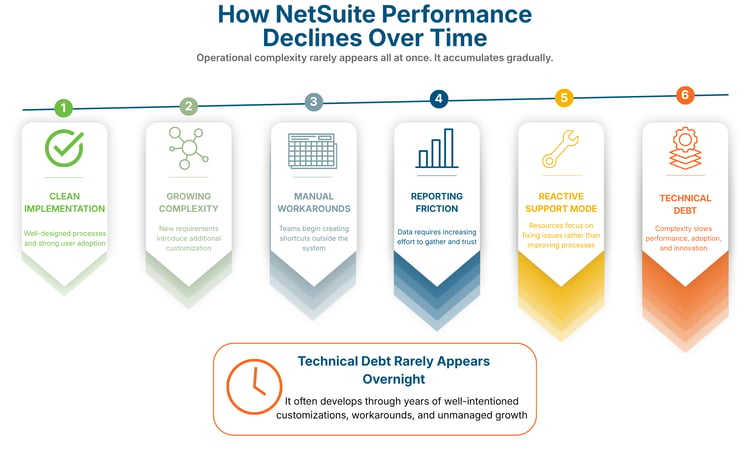
NetSuite Performance Is About More Than System Speed
When companies talk about ERP performance, they often think only about technical system responsiveness. But operational performance matters just as much. A NetSuite environment may technically load quickly while still creating significant operational inefficiencies. Performance decline often appears through:
- Growing spreadsheet dependency
- Complicated workflows
- Reporting friction
- Inconsistent processes
- Slow operational approvals
- Reduced user adoption
- Difficulty implementing changes
- Recurring support issues
These operational symptoms are often early warning signs that the ERP environment is becoming increasingly difficult to manage effectively.
Business Growth Naturally Creates Complexity
One of the main reasons NetSuite environments become harder to manage over time is simple: businesses evolve. As organizations grow, they often add:
- New product lines
- Additional subsidiaries
- More users
- New integrations
- Expanded reporting requirements
- Additional approval layers
- Department specific processes
- Custom operational workflows
Each individual change may seem reasonable. Together, however, they gradually increase operational complexity throughout the ERP environment.
Quick Fixes Create Long Term Friction
Many NetSuite environments accumulate operational complexity through years of reactive decision making. Examples include:
- Temporary workflows becoming permanent
- Duplicate processes created to solve short term issues
- Additional fields and forms added without governance
- Disconnected reporting logic
- Spreadsheet workarounds replacing process improvements
- Customizations added without long term planning
These decisions are often made with good intentions and under operational pressure. Over time, however, they reduce clarity, increase training difficulty, and make future changes more complex to implement. What began as a practical workaround becomes structural debt.
The Post Go Live Investment Gap
A third factor driving performance decline is an underinvestment in NetSuite optimization after go live. Implementation projects often receive significant budget and attention. Post go live support frequently receives less. Many companies assume the primary investment happens during implementation and that ongoing costs should be minimal. In practice, the opposite is often true. The business continues to evolve. The system must evolve with it. Without consistent investment in optimization, governance, and refinement, the environment slowly drifts away from where the business actually operates. This gap widens over time, and the cost of closing it grows with every quarter it is left unaddressed.
Early Warning Signs of Performance Decline
Operational performance decline rarely announces itself through a single visible failure. It tends to arrive quietly, embedded in the daily habits of users who have quietly adapted to a system that is no longer working as well as it should. Recognizing the early warning signs allows leadership to address the root causes before the situation becomes significantly more difficult and expensive to reverse.
The following are specific, observable indicators that a NetSuite environment may be declining in operational performance:
- Spreadsheet proliferation: Finance, operations, or sales teams begin maintaining data outside of NetSuite to compensate for reporting gaps, inconsistent records, or system outputs they no longer fully trust. When spreadsheets become the primary tool for month- end close, revenue tracking, or inventory oversight, the ERP has lost its role as the system of record.
- Increasing support ticket volume: If the number of help requests submitted by users is growing month over month, that is a signal that the system is generating friction rather than reducing it. Recurring tickets on the same topics indicate the underlying issue is never fully resolved.
- Approval bottlenecks: Purchase orders, expense reports, and operational approvals that routinely sit in queues longer than expected often point to workflow configurations that no longer reflect the organization's actual approval structure.
- New hire onboarding difficulty: When new employees consistently require weeks to become productive in NetSuite, it is often because the system has accumulated too many inconsistencies, undocumented workarounds, and non-intuitive configurations for users to navigate efficiently.
- Saved search and report distrust: When department heads begin questioning whether their NetSuite reports reflect reality, or when multiple versions of the same report circulate with conflicting results, reporting governance has broken down.
- Change resistance: If internal teams have become reluctant to implement even minor changes in NetSuite because prior changes created unintended consequences, the environment has become too complex and fragile to manage with confidence.
- Integration failures going undetected: When data synchronization issues between NetSuite and connected platforms are discovered only after they have caused downstream problems, real-time monitoring and integration governance are absent.
Any one of these signs warrants attention. When multiple indicators appear simultaneously, it is a strong signal that the environment requires a structured optimization effort rather than continued reactive support.
How to Measure Operational Performance in NetSuite
Unlike technical performance metrics such as page load times or system uptime, operational performance in NetSuite is rarely tracked through a formal measurement framework. Leadership teams that want to proactively manage ERP performance should consider tracking the following specific metrics:
- Support ticket volume and resolution time: Track the number of support requests submitted per month, the average time to resolution, and the percentage of tickets that are repeat issues. A rising repeat issue rate indicates systemic problems rather than isolated incidents.
- Workflow completion rate and cycle time: Measure how long it takes for transactions such as purchase orders, invoices, and expense reports to move through the approval process from creation to completion. Increasing cycle times reveal bottlenecks in workflow configuration or user behavior.
- Spreadsheet usage frequency: Survey department heads quarterly about how frequently their teams export NetSuite data to spreadsheets to complete work. An increase in this number is a reliable proxy for system trust and usability problems.
- Report accuracy rate: Track how often saved searches and financial reports need to be manually corrected or reconciled before distribution. Inaccurate or inconsistent reports signal problems in data entry standards, mapping logic, or reporting configuration.
- User adoption rate by role: Monitor login frequency and feature usage by role group. Declining usage in specific departments often reveals that those teams have found workarounds outside the system.
- Time to implement changes: Track how long it takes to implement configuration changes, workflow updates, or new report builds from request to deployment. Increasing implementation times suggest the environment has become more complex and interdependent over time.
Establishing a baseline for each of these metrics and reviewing them on a quarterly basis gives leadership early visibility into operational decline well before it reaches a crisis point.
Measuring Operational Performance Decline
Unlike technical performance, operational performance decline often goes unmeasured. There are no dashboards tracking how much time users spend on workarounds, how many saved searches return inconsistent results, or how many workflow approvals are delayed every week. Without visibility into these operational metrics, the decline often goes unnoticed until it has become significant. By the time leadership recognizes the problem, the underlying causes have typically been building for months or years.
How Managed Services Help Prevent and Reverse Performance Decline
A managed services partner helps companies maintain and improve NetSuite performance over time by providing ongoing optimization, governance, and strategic guidance. Rather than waiting for performance to decline, managed services create a structure for continuous improvement. Regular reviews of workflows, reports, integrations, and user adoption help identify friction before it compounds. When the business changes, the system is updated proactively instead of reactively. When performance gaps emerge, they are addressed systematically rather than left unresolved until they become urgent.
In practice, reversal of performance decline through managed services looks like specific, observable improvements over a structured engagement period. Workflows that had grown tangled with redundant steps are audited and rebuilt to reflect how approvals actually move through the organization today. Saved searches and reports that had diverged into multiple conflicting versions are consolidated into a single governed reporting layer with consistent logic. Integrations that had been silently failing or producing mismatched data are stabilized through monitoring and exception alerts. Fields, forms, and records that accumulated without governance are reviewed and a rationalized data structure is established to simplify navigation for all users.
Beyond these corrective actions, a strong managed services partner also establishes the governance mechanisms that prevent decline from recurring. This includes documented change management processes, recurring optimization reviews aligned to business priorities, and a structured approach to NetSuite release planning that ensures updates do not disrupt existing configurations. Users receive targeted training that addresses the specific gaps driving spreadsheet dependency and system avoidance. Over time, the ERP environment becomes something the business can rely on again rather than something it works around.
Client Spotlight
Recovering Month-End Close Speed Through Cost Engine Optimization
A growing technology company was experiencing progressively slower month-end close cycles. The root cause was NetSuite cost engine processing time, which had become a material bottleneck as transaction volume scaled. Finance leadership flagged the issue as a risk to reporting timelines and began evaluating options — uncertain whether the problem required a platform change or could be resolved through configuration work alone.
A targeted performance optimization engagement addressed cost engine configuration, data volume management, and processing sequence — requiring deep technical expertise in how NetSuite handles cost calculations at scale. The result was a materially faster close cycle that restored finance team confidence in the platform and eliminated the processing bottleneck that had been constraining month-end reporting speed as the business grew.
Industry: Technology | Outcome: Month-end close speed recovered; cost engine performance optimized at scale
Frequently Asked Questions
Why does NetSuite performance decline over time even if nothing breaks?
Performance decline in NetSuite is primarily operational rather than technical. As a business grows and changes, its processes evolve, but the NetSuite configuration often does not evolve with them. The result is a growing gap between how the system is built and how the business actually operates, which surfaces as manual workarounds, reporting inaccuracies, and user avoidance rather than system errors or downtime.
What are the early warning signs that NetSuite performance is declining?
Observable early warning signs include spreadsheet proliferation outside NetSuite, a growing volume of support tickets month over month, approval bottlenecks in purchase orders and expense reports, difficulty onboarding new hires into the system, finance and operations teams questioning the accuracy of standard reports, and internal reluctance to implement even minor system changes. Any one of these warrants attention; multiple signs appearing simultaneously indicate significant performance decline.
How does business growth cause NetSuite performance to decline?
Business growth introduces new products, entities, workflows, users, and integration requirements that the original implementation was not designed to accommodate. Without proactive configuration updates, the system accumulates workarounds and modifications that address immediate needs without considering long-term architecture. Over time, this complexity makes the environment harder to maintain, slower to change, and less aligned with actual operational requirements.
How do I measure operational performance in NetSuite?
Operational performance in NetSuite is measured through metrics including support ticket volume and resolution time, workflow completion rate and cycle time for key transactions, frequency of spreadsheet exports as a proxy for system distrust, report accuracy rate tracking how often outputs require manual correction, user adoption rate by role, and the average time required to implement configuration changes. Establishing baselines for these metrics and reviewing them quarterly provides early visibility into performance trends.
Can NetSuite operational performance decline be reversed?
Yes, operational performance decline can be reversed through targeted configuration remediation, process realignment, documentation of existing customizations, and the establishment of ongoing governance and optimization practices. Reversal is not a one- time project — it requires sustained attention and structured improvement cycles that address both the accumulated backlog and the root causes of future drift.
What role do quick fixes play in long-term NetSuite performance decline?
Quick fixes address immediate problems without considering downstream implications or documenting the rationale for the change. Over time, these fixes accumulate into an environment where customizations interact in undocumented ways, where the original intent of configurations is unknown, and where each new change carries the risk of breaking something unexpected. The cumulative effect is an environment that becomes progressively more difficult and expensive to maintain and improve.
Looking to Improve NetSuite Performance?
The Vested Group helps companies maintain and improve NetSuite performance through inVESTED PRO managed services. If the environment is becoming harder to manage, less trusted by users, or less aligned with how the business actually operates, a structured managed services engagement can help identify and address the sources of operational decline.

Candice Harris
Candice Harris is a Senior Consultant at The Vested Group with more than 20 years of accounting and financial leadership experience. As a former controller and NetSuite end user, she helps organizations optimize financial operations through practical, real-world ERP solutions. Candice specializes in financial management, Procure to Pay (P2P), Order to Cash (O2C), Record to Report (R2R), inventory management, advanced revenue management, intercompany accounting, and Avalara integrations, helping clients maximize the value of their NetSuite investment.