.png "The Vested Group | NetSuite Solution Provider Partner | NetSuite Consulting | NetSuite Support")
US-based NetSuite support teams generally outperform offshore teams in engagements that require strategic judgment, real-time communication, and deep business context, while offshore teams can be effective for well-defined, repeatable, and low-stakes tasks. The total cost of an offshore engagement frequently exceeds the apparent per-hour savings once re-work cycles, clarification overhead, and escalation delays are accounted for. The right question is not one of geography but of whether the team has the depth and context to make NetSuite better for your business over time.
One of the most common questions organizations ask when evaluating NetSuite managed services is whether to choose a US-based team or an offshore one. The question is understandable, the price difference can be substantial, and the budget pressure is real. But framing the decision primarily around cost misses most of what determines whether a managed services engagement actually succeeds.
The right choice depends on the type of support you need, how your team operates, and how much business context is required to deliver value. This guide examines both models honestly, outlines where each performs well and where each falls short, and helps you evaluate the decision with the right framework.
The Right Choice Depends on the Type of Support Needed
Not all NetSuite support is the same. Some support is highly transactional, password resets, basic saved search modifications, data exports, and routine configuration changes that are well-documented and reproducible. Other support is deeply contextual, diagnosing a revenue recognition discrepancy, advising on how to restructure an approval workflow to match a new organizational design, or recommending which NetSuite features should be activated to support a new business line.
Transactional support can be delivered effectively from almost anywhere with a reliable internet connection and a trained consultant. Contextual support, the kind that requires understanding your business model, your industry dynamics, and your team's way of working, is harder to deliver across significant time zone gaps, language nuance differences, and cultural distance.
The decision between US-based and offshore support is really a question about which type of support dominates your engagement.
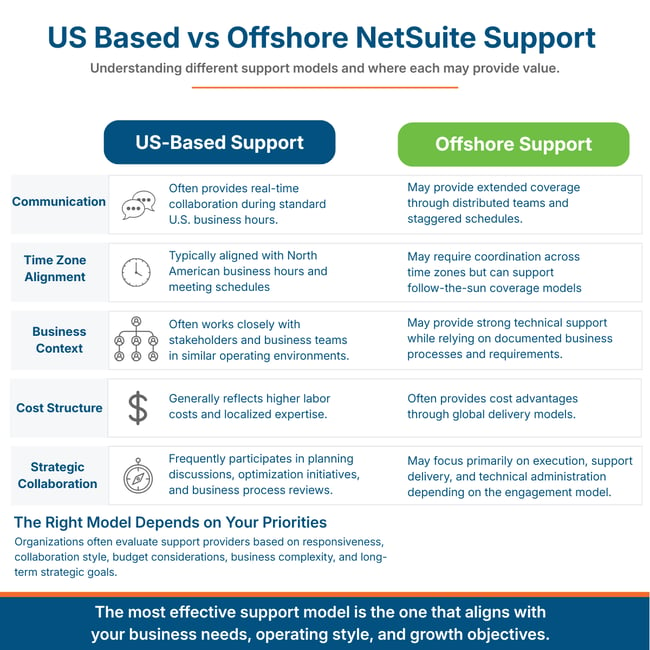
Communication and Time Zone Alignment
Time zone alignment is more than a scheduling convenience. When your controller discovers a discrepancy during a month-end close at 4:00 PM on a Tuesday, the ability to reach a knowledgeable consultant immediately has real business impact. A team operating twelve hours away may not be available until the issue has already affected the close process.
Offshore teams often address this with overnight coverage models, which can work well for some types of requests. But coverage is not the same as availability. A consultant who picks up a ticket at 2:00 AM local time and resolves it before the client's business day begins is different from a consultant who is engaged, available, and able to have a real-time conversation during business hours.
Real-time conversation matters more than organizations often acknowledge when evaluating this decision. Many ERP issues require dialogue, clarifying questions, context gathering, iterative problem solving — before they can be resolved. A support model that relies primarily on asynchronous ticket exchange slows down that process significantly.
Business Context Matters for ERP Support
NetSuite is not a standalone application. It is the operating backbone of a business — touching finance, operations, supply chain, and customer management in ways that are deeply intertwined with how the organization works. Supporting it effectively requires understanding that organization in detail.
Context accumulates over time. A team that has supported your environment for eighteen months knows your chart of accounts, understands why your approval workflows are structured the way they are, remembers the decisions made during implementation that affect current behavior, and can interpret a vague support request ("the PO process is breaking again") without needing the requester to write a detailed specification.
Building this context is harder across communication barriers. It is not impossible, but it requires more deliberate effort and more structured documentation than most offshore engagements invest in. The result, in practice, is often that business context is rebuilt repeatedly rather than accumulated, and that cost is borne by the client in the form of longer resolution times and more requirement clarification cycles.
Cost Is Only One Part of the Decision
The headline cost difference between US-based and offshore managed services is real. Offshore rates are frequently thirty to sixty percent lower on a per-hour basis. For organizations with constrained budgets and primarily transactional support needs, that difference is meaningful.
But cost analysis that stops at the hourly rate misses several important factors. It does not account for the time your internal team spends writing detailed requirements for offshore consultants who cannot gather context through conversation. It does not account for rework when requirements are misunderstood. It does not account for escalation delays when an issue requires judgment that was not documented in the ticket. And it does not account for the value that is never created because the offshore team does not identify improvement opportunities that a more deeply engaged partner would surface.
Total cost of ownership is the right frame for this decision, not hourly rate.
When Offshore Works Well
Offshore NetSuite support is most effective when the work is well-defined, repeatable, and low-stakes for errors. Data migration tasks with clear mapping documentation, routine report modifications based on existing templates, basic user administration, and technical development work that has been fully specified by a functional lead are all areas where offshore teams can deliver cost-effective results.
It also works well when there is strong oversight and governance on the client side, typically an internal NetSuite lead or a US-based functional consultant who reviews all offshore output before it reaches production. This hybrid model can capture some cost savings while managing the quality and context risks that fully offshore delivery introduces.
When US-Based Is a Better Fit
US-based teams tend to outperform offshore teams in engagements that require strategic judgment, frequent real-time communication, or deep business context. If your managed services engagement includes executive dashboard development, continuous improvement planning, release management advisory, and proactive recommendations, as a high-quality engagement should, the value of that work depends heavily on the team's ability to understand and engage with your business.
Organizations that are going through significant change, rapid growth, acquisitions, new product lines, operational restructuring, also tend to benefit more from US-based support. Change requires context, judgment, and the ability to have real conversations quickly. Offshore models that rely on ticket-based asynchronous communication are not well-suited to environments in flux.
The Hidden Costs of Misalignment
Organizations that choose offshore support primarily on cost often encounter a set of costs they did not anticipate. Requirement clarification cycles extend resolution timelines when the consulting team needs more information than the requester provide, and in many offshore models, each clarification round adds a full business day to the timeline due to time zone gaps.
Ticket re-open rates (the frequency with which resolved tickets are reopened because the resolution did not address the actual issue) tend to be higher in offshore engagements where business context is lower. Each re-open represents not just a delay but a signal that the first resolution consumed resources without producing value.
Escalation delays are another hidden cost. When an issue requires judgment that the offshore team cannot provide, it escalates to a more senior resource, who is often also in a distant time zone and may not have more context than the first-tier team. The escalation path in offshore models is frequently slower and less effective than in US-based models where senior and junior resources operate in the same context.
Finally, the frequency of proactive recommendations, one of the most valuable outputs of a high-quality managed services engagement, tends to be lower in offshore models. Proactive recommendations require curiosity about the client's business and confidence in proposing change. Both are harder to sustain across communication and cultural barriers.
How to Audit an Offshore Team's Effectiveness
If you are currently using or seriously considering an offshore team, there are specific metrics that reveal whether the engagement is delivering real value. Monitor the ticket re-open rate — if more than ten to fifteen percent of tickets are reopened after resolution, the team is resolving symptoms rather than causes. Track average time to resolution by issue type, and compare that to what a US-based team benchmarks for similar work.
Measure the frequency of proactive recommendations. A high-quality managed services engagement should generate documented improvement recommendations from the provider on a regular cadence, not just responses to client-initiated requests. If the provider never brings a recommendation you did not ask for, they are operating in a purely reactive mode regardless of their time zone.
Track recurring issue rate, how often the same issue or category of issue reappears after resolution. High recurrence suggests that issues are being patched rather than resolved at the root cause, which is a common pattern in low-context engagements where the team does not understand the business well enough to identify systemic causes.
Questions to Ask During Evaluation
When evaluating offshore or hybrid managed services options, ask specific questions that reveal how the team manages the risks of the model. What are the exact hours of coverage, and which team members are available during those hours? Who handles requests that require strategic judgment rather than technical execution? How does the team build and maintain knowledge of the client environment over time, and where is that knowledge documented?
Ask how ambiguous requirements are handled. In a US-based model, ambiguity is often resolved through a quick phone call. In an offshore model, it is typically handled through an asynchronous clarification cycle. Understanding how that process works, and how long it typically takes, gives you a realistic picture of what issue resolution will look like for complex requests.
Also ask what the escalation path looks like for issues that the primary team cannot resolve. Is there a US-based escalation resource? What is the expected response time for escalated issues? Who makes the determination that escalation is needed, and how is that communicated to the client?
The Hybrid Model: When and How It Works
Some organizations adopt a hybrid model in which US-based consultants handle strategic, contextual, and high-stakes work while offshore resources handle defined, repeatable, and lower-stakes tasks. When this model is well-governed, it can capture cost savings without sacrificing the quality of strategic support.
For the hybrid model to work, several conditions must be in place. There must be a US- based lead who owns the client relationship, sets priorities, reviews all offshore output before it reaches production, and serves as the primary escalation point. The offshore team must have clear scope boundaries, they should not be making independent judgments about requirements, priorities, or business-process implications.
Documentation must be rigorous and current. Because the offshore team operates with less business context than a fully US-based team, they are more dependent on written specifications and documented decision history. If that documentation is incomplete or out of date, the quality of offshore output degrades quickly.
Support Quality Matters More Than Location Alone
The most important insight in this decision is that location is a proxy variable. What actually determines support quality is the team's depth of business understanding, their ability to communicate effectively with your stakeholders, the maturity of their support processes, and their commitment to proactive improvement rather than reactive maintenance.
Some offshore teams deliver better quality than some US-based teams. And some US-based teams are as reactive and low-context as any offshore alternative. Location is a useful heuristic, but it is not a substitute for evaluating the specific team, their processes, their track record, and their philosophy of engagement.
The question to answer is not "US-based or offshore?" but rather "does this team have what it takes to make NetSuite better for our business over time?" That question has the same answer regardless of geography.
Frequently Asked Questions
What is the main difference between US-based and offshore NetSuite support teams?
The primary difference is business context and real-time availability. US-based teams can engage in real-time dialogue, accumulate deep client context through ongoing conversation, and make judgment calls that require understanding your business model. Offshore teams are often effective for transactional, well-documented tasks but tend to underperform when support requires contextual problem-solving, rapid escalation, or strategic recommendation.
Is offshore NetSuite support significantly less expensive?
Offshore hourly rates are frequently thirty to sixty percent lower than US-based rates, but the total cost of ownership is often higher when accounting for clarification cycles, ticket re- open rates, internal oversight burden, and the reduced frequency of proactive recommendations. Organizations that evaluate managed services on hourly rate alone often find that offshore engagements cost more in total staff time and rework than the apparent savings suggest.
When does offshore NetSuite support actually work well?
Offshore support is most effective when the work is well-defined, repeatable, and low- stakes for errors — data migration tasks with clear mapping documentation, routine report modifications based on existing templates, and basic user administration. It also works in hybrid models where a US-based functional consultant reviews all offshore output before it reaches production and serves as the primary client relationship manager.
What are the hidden costs of using an offshore NetSuite support team?
The most common hidden costs include the internal team time required to write detailed requirements for consultants who cannot gather context through conversation, elevated ticket re-open rates when resolutions miss the actual business issue, and escalation delays when issues require judgment that the offshore team cannot provide. The frequency of proactive recommendations, one of the most valuable outputs of a high-quality engagement, also tends to be lower in offshore models.
What metrics reveal whether an offshore NetSuite team is delivering real value?
Monitor the ticket re-open rate: if more than ten to fifteen percent of resolved tickets are subsequently reopened, the team is resolving symptoms rather than root causes. Measure the frequency of proactive recommendations — a high-quality engagement should generate documented improvement suggestions on a regular cadence, not just responses to client requests. Track recurring issue rates to determine whether problems are being permanently resolved or repeatedly patched.
What is a hybrid NetSuite support model and when does it work?
A hybrid model uses US-based consultants for strategic, contextual, and high-stakes work while offshore resources handle defined, repeatable, and lower-stakes tasks. For this to work effectively, a US-based lead must own the client relationship, review all offshore output before production deployment, and serve as the primary escalation point. Documentation must be rigorous and current, since offshore team members are more dependent on written specifications than teams that can gather context through conversation.
How does inVESTED PRO approach NetSuite support team composition?
inVESTED PRO is staffed by a US-based team with deep functional and technical expertise across a wide range of industries and NetSuite configurations. The program is built around the qualities that determine long-term support value — business context, real-time availability, proactive recommendations, and team-based continuity — rather than on geographic arbitrage alone.
Partner with a Team Built for Long-Term Value
inVESTED PRO is The Vested Group's managed services program, staffed by a US-based team with deep functional and technical expertise across a wide range of industries and NetSuite configurations. The inVESTED PRO model is built around the qualities that drive long-term value, named teams, real-time availability, proactive recommendations, rigorous documentation, and a continuous improvement cadence that helps NetSuite evolve with the business.
If you are evaluating your current support model or exploring managed services for the first time, contact The Vested Group to learn how inVESTED PRO compares to what you have today.

Candice Harris
Candice Harris is a Senior Consultant at The Vested Group with more than 20 years of accounting and financial leadership experience. As a former controller and NetSuite end user, she helps organizations optimize financial operations through practical, real-world ERP solutions. Candice specializes in financial management, Procure to Pay (P2P), Order to Cash (O2C), Record to Report (R2R), inventory management,