.png "The Vested Group | NetSuite Solution Provider Partner | NetSuite Consulting | NetSuite Support")
ERP governance is the set of ownership structures, processes, standards, and controls that ensure a NetSuite environment is managed well after go-live — covering who owns the system, how changes are made and documented, how access is reviewed, and how improvement priorities are set. Without it, configurations drift, documentation becomes outdated, access accumulates without review, and reporting reliability declines in ways that compound over months and years. Effective governance does not require a large team or a complex bureaucracy; it requires clarity of roles, documented processes, and a consistent review cadence.
When an ERP implementation ends and the system goes live, most organizations shift their attention to adoption, training, and stabilization. Governance — the ongoing structures, processes, and standards that ensure the system is managed well over time — often receives far less attention than it deserves.
That gap creates problems that compound over months and years. Without governance, ERP systems drift. Configurations are made without documentation. Access is granted without review. Workarounds become permanent. Reports lose their reliability. And when something goes wrong — a compliance finding, an audit failure, a data integrity issue — there is no clear owner and no defined process for addressing it.
ERP governance is not bureaucracy for its own sake. It is the operating model that protects your investment, maintains the quality of your data, and ensures the system continues to serve the business as it evolves.
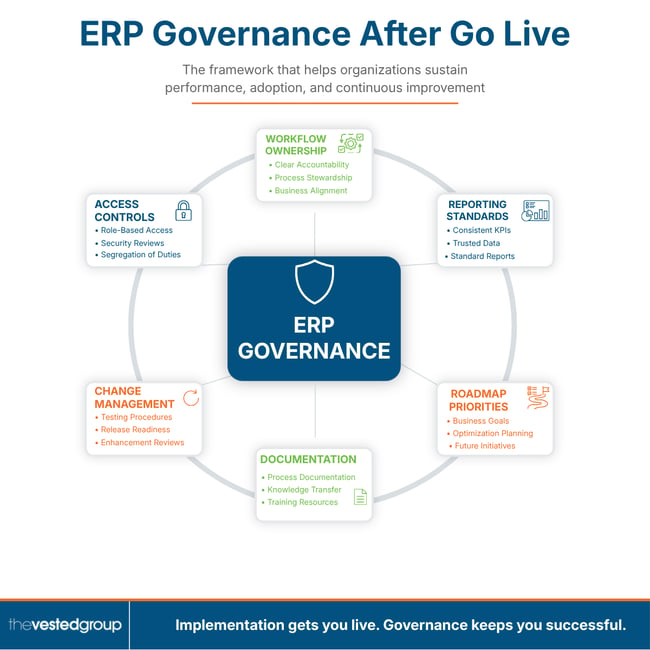
What ERP Governance Means
ERP governance encompasses the ownership structures, processes, standards, and controls that guide how the system is managed after go-live. It answers questions like: Who owns the system? Who decides what changes get made and in what order? How are changes documented and tested? What standards apply to configuration, naming, and data entry? How are access and security controls maintained? How does the organization manage change when processes or requirements evolve?
Governance does not require a large team or a complex bureaucracy. It requires clarity. When roles are defined, processes are documented, and standards are enforced, even a small team can manage a complex ERP system effectively. When those elements are absent, even a large team will struggle to keep up with the system's demands.
Why Governance Matters After Go-Live
During implementation, governance exists by default. A project team owns decisions. A project manager tracks changes. A defined scope constrains what gets built. Consultants document configurations. Testing is required before go-live.
When the project ends, those structures disappear. The project team disperses. The consultant engagement closes. The project manager moves to the next initiative. What remains is the system, the users, and whatever internal capacity exists to manage both.
Without deliberate governance structures to replace the project team, the discipline of implementation gradually erodes. Changes are made informally. Documentation falls out of date. Access accumulates without review. The system that was clean and well-structured at go- live becomes harder to manage with each passing quarter.
The Real Cost of Poor ERP Governance
The consequences of inadequate governance show up in several ways, all of them costly:
- Reporting failures: When configuration changes are made without documentation or testing, reports break. Financial statements produce errors. Operational dashboards show inconsistent data. These failures erode trust in the system and create manual reconciliation work that consumes significant time every close cycle.
- Compliance exposure: Access controls that are not regularly reviewed create segregation-of-duties violations. Configuration changes made without proper authorization create audit findings. Poor documentation makes it impossible to demonstrate to auditors what the system is doing and why.
- Operational disruption: Undocumented changes create unexpected downstream effects. A workflow change that fixes one problem breaks another process. An integration adjustment causes transaction failures that are not discovered until the end of the month.
- Technical debt: Without standards for how configurations are built and documented, the system accumulates layers of custom scripting, saved searches, and workarounds that are poorly understood and difficult to maintain. This technical debt makes future changes more expensive and more risky.
- Talent and transition risk: When system knowledge lives in the heads of one or two individuals rather than in documentation, the departure of those individuals creates a crisis. Governance — including documentation standards and knowledge transfer processes — is the primary defense against this risk.
Governance Protects Reporting Quality
For most organizations, the quality of ERP reporting is directly tied to the quality of ERP governance. Financial reporting, operational dashboards, and management metrics all depend on data that is entered consistently, processed correctly, and structured in a way that supports meaningful analysis.
When configuration changes are made without governance controls, reporting breaks down in ways that are often invisible until a decision is made based on bad data. A chart of accounts change that is not coordinated with the reporting team produces financial statements that cannot be compared to prior periods. A workflow modification that is not tested properly causes transactions to post to the wrong account. A new saved search that uses different criteria than the existing report produces numbers that do not reconcile.
Governance prevents these failures by requiring that changes go through a defined review and testing process before they are deployed. It ensures that the people who depend on reports are consulted before changes are made to the systems that feed those reports.
Governance Reduces Technical Debt
Technical debt in an ERP system accumulates when changes are made without standards, documentation, or review. A custom script built to solve an immediate problem, documented nowhere, tested only informally, and never reviewed again becomes a liability when the business process it supports changes or when the person who built it leaves.
Governance reduces technical debt by establishing standards for how customizations are built and documented, requiring peer review before deployment, and scheduling regular reviews of the custom configuration layer to identify and remediate items that have become obsolete or problematic.
This does not mean eliminating customization. It means managing it with the same discipline that is applied to other business assets.
Governance Improves Prioritization
One of the less obvious benefits of ERP governance is its effect on how improvement work gets prioritized. Without a governance structure, enhancement requests are managed informally. The department with the most political capital or the loudest voice tends to get its requests addressed first. High-value items from quieter departments go unaddressed. Low-value items from influential stakeholders consume resources that could be used more effectively elsewhere.
A governance framework creates a defined intake process, evaluation criteria, and decision- making structure that distributes prioritization more equitably and more rationally. When every request goes through the same process and is evaluated against the same criteria, the best decisions tend to surface.
What a Practical Governance Framework Looks Like
ERP governance does not need to be complex to be effective. A practical framework includes five core elements:
- A named system owner: One person has ultimate accountability for the ERP system. This does not mean they do all the work — it means they are responsible for ensuring that governance processes are followed, decisions are made in a timely way, and the system is managed in alignment with business needs.
- A cross-functional governance group: A small group with representation from Finance, Operations, IT, and other major system users meets regularly to review priorities, evaluate change requests, and ensure that system decisions reflect the needs of the whole organization rather than a single department.
- A change management process: All changes to the system — configuration, scripting, integration, access — go through a defined process that includes documentation, testing, approval, and post-deployment review. Emergency changes have a defined fast-track process that still requires documentation after the fact.
- Documentation standards: Configuration, customization, and integration are documented to a defined standard. Documentation is maintained as changes are made, not reconstructed after the fact.
- A regular review cycle: The governance group meets on a defined cadence — typically monthly for operational triage and quarterly for roadmap planning — and conducts periodic reviews of access, technical debt, and system health.
Key Areas to Govern
A well-designed governance framework covers eight key areas of the ERP system:
- Access and security: Who has access to what, and is that access appropriate? Quarterly access reviews reduce the risk of segregation-of-duties violations and unauthorized access.
- Configuration changes: Any change to standard NetSuite configuration — forms, workflows, saved searches, custom fields — should go through the change management process.
- Custom scripting: Scripts require design review, testing, documentation, and periodic review for continued relevance and performance.
- Integrations: Third-party integrations require monitoring, error handling review, and periodic assessment of whether the integration is performing as intended.
- Data standards: Naming conventions, data entry standards, and master data management rules ensure that the data in the system is consistent and reliable.
- Reporting and analytics: Reports and dashboards should be owned, documented, and reviewed periodically to ensure they are producing accurate, current information.
- Release management: NetSuite releases twice per year. Governance includes reviewing release notes, testing in sandbox, and making deliberate decisions about which new features to adopt.
- Vendor and consultant management: Engagements with external parties who touch the system should be governed to ensure work meets quality standards and is properly documented.
How to Get Leadership Buy-In
ERP governance initiatives sometimes struggle to get leadership attention because they appear to be internal process work rather than strategic priorities. The key to gaining buy-in is connecting governance to the outcomes that executives care about.
Reporting integrity is a compelling frame for finance leadership: governance ensures that the numbers used to make decisions are accurate and reliable. Audit risk resonates with CFOs and audit committees: poor governance creates findings that damage credibility and consume resources to remediate. Technology cost is relevant to any executive reviewing the IT budget: technical debt created by ungoverned systems makes future changes more expensive. Access risk speaks to legal and compliance leadership: access control failures create regulatory exposure that governance prevents.
Framing governance as a risk management and reporting quality initiative — rather than an internal IT process — tends to generate the executive support necessary to fund and sustain it.
Common Governance Failures and How to Avoid Them
Four governance failures appear repeatedly in organizations that attempt to implement ERP governance but struggle to sustain it:
- Ownership without authority: Naming a system owner is not enough if that person does not have the authority to enforce governance decisions. The system owner needs organizational backing to require that change requests go through the defined process, even when departments push back.
- A committee without decision rights: A governance group that can only recommend but not decide will quickly lose credibility. Decision rights need to be defined and respected. The group needs to know what it can approve, what requires escalation, and who makes the final call on disputes.
- Documentation that is not maintained: Documentation standards are only valuable if they are followed. Governance reviews should include audits of documentation currency. When documentation falls behind, it should be treated as a deficiency requiring remediation.
- Treating governance as a one-time exercise: Governance is not a project that has a completion date. It is an ongoing operating model. Organizations that build governance structures and then stop maintaining them revert to ungoverned states within months.
Governance Does Not Need to Be Bureaucratic
A common objection to ERP governance is that it will slow things down. This concern is understandable but misplaced. The goal of governance is not to add friction — it is to prevent the kind of uncontrolled change that creates much larger problems downstream.
A well-designed governance process for a routine configuration change should take days, not weeks. An emergency change process should allow same-day deployment with documentation to follow. The overhead of governance is modest compared to the cost of recovering from an ungoverned change that breaks reporting, creates a compliance finding, or disrupts operations.
The organizations that find governance burdensome are usually those that have designed it without attention to efficiency. Streamlined intake forms, defined service levels, and clear decision rights make governance functional rather than obstructive.
How Managed Services Support Ongoing Governance
Sustaining ERP governance requires ongoing capacity, expertise, and process discipline that many organizations struggle to maintain with internal resources alone. A managed services partner can provide structural support for governance in several ways: documenting and maintaining configuration, monitoring system health, conducting access reviews, reviewing release notes proactively, and serving as a consistent point of expertise even as internal staff turn over.
The inVESTED PRO managed services program from The Vested Group is designed with governance built in. Clients benefit from structured review cycles, proactive monitoring, documentation maintenance, and access to senior NetSuite expertise — all within a framework that supports rather than replaces internal ownership.
Frequently Asked Questions
What is ERP governance and why does it matter for NetSuite?
ERP governance is the ongoing operating model that determines how your NetSuite environment is managed after implementation ends. It covers ownership accountability, change management process, documentation standards, access review cadence, and prioritization structure. Without governance, ERP systems drift — configurations are made informally, documentation falls out of date, and the system that was clean and well-structured at go-live gradually becomes difficult to understand and maintain.
What are the core components of a practical ERP governance framework?
A practical governance framework includes five elements: a named system owner with clear accountability, a cross-functional governance group with representation from Finance, Operations, IT, and other major users, a defined change management process that covers all system changes from configuration to scripting, documentation standards that are maintained as changes are made, and a regular review cycle that includes monthly triage and quarterly roadmap planning.
How often should we conduct NetSuite access reviews?
Access reviews should be conducted at least quarterly. Without regular review, access accumulates over time — users who change roles retain permissions they no longer need, departed employees may retain active accounts, and segregation-of-duties violations develop gradually. Quarterly reviews catch these issues before they become audit findings and ensure that access controls accurately reflect current organizational roles and responsibilities.
What happens to a NetSuite environment without ERP governance?
Without governance, the consequences are predictable and costly. Reporting breaks as configuration changes are made without documentation or testing. Compliance exposure grows as access controls go unreviewed. Technical debt accumulates as undocumented customizations layer on top of each other. When key administrators leave, institutional knowledge walks out with them — because governance documentation was never maintained. These problems compound quietly until a compliance finding, reporting failure, or data integrity crisis makes them impossible to ignore.
How do we get leadership buy-in for an ERP governance initiative?
The most effective approach is to connect governance to outcomes that executives already care about. Reporting integrity is compelling for finance leadership: governance ensures that the numbers used to make decisions are accurate and reliable. Audit risk resonates with CFOs and audit committees: poor governance creates findings that damage credibility and require remediation resources. Framing governance as a risk management and reporting quality initiative — rather than an internal IT process — tends to generate the executive support necessary to fund and sustain it.
Does ERP governance slow down system change requests?
A well-designed governance process for a routine configuration change should take days, not weeks. An emergency change process should allow same-day deployment with documentation to follow. The overhead of governance is modest compared to the cost of the problems it prevents: uncoordinated changes that break reports, create audit findings, or introduce downstream process failures. Organizations that find governance burdensome are usually those that have designed it without attention to efficiency — streamlined intake forms, defined service levels, and clear decision rights make governance functional rather than obstructive.
Can a managed services partner help implement and sustain ERP governance?
A managed services partner can provide structural support for governance in several ways: conducting regular configuration health reviews, maintaining documentation as changes are made, running access review cycles, monitoring system performance and flagging emerging issues, and providing the senior NetSuite expertise required to evaluate change requests accurately. inVESTED PRO from The Vested Group is designed with governance built in, so clients benefit from these structures without having to build and staff them entirely from internal resources.
Build Governance Before You Need It
The organizations that struggle most with ERP governance are those that wait until something goes wrong to address it. A compliance finding, a reporting failure, or a major data integrity issue can trigger a governance initiative — but it is far more expensive to remediate ungoverned systems than to govern them from the start.
If your organization has been operating without a formal ERP governance framework, now is the right time to build one. The Vested Group helps NetSuite customers design and implement governance structures that are practical, sustainable, and aligned with the needs of the business. Contact us to learn how inVESTED PRO can support your governance objectives.

Jon Leander
Jon Leander is a Solution Architect at The Vested Group with more than 22 years of accounting and financial leadership experience, including over 9 years working with NetSuite. Drawing on his background as a controller, director of finance, NetSuite administrator, and application architect, Jon helps organizations optimize their ERP investment through strategic consulting, process improvement, and ongoing system enhancements. He specializes in financial management, revenue recognition, reporting and analytics, Procure to Pay (P2P), Order to Cash (O2C), Record to Report (R2R), SuiteAnalytics, and NetSuite integrations, helping clients improve operational efficiency and long-term business performance.