.png "The Vested Group | NetSuite Solution Provider Partner | NetSuite Consulting | NetSuite Support")
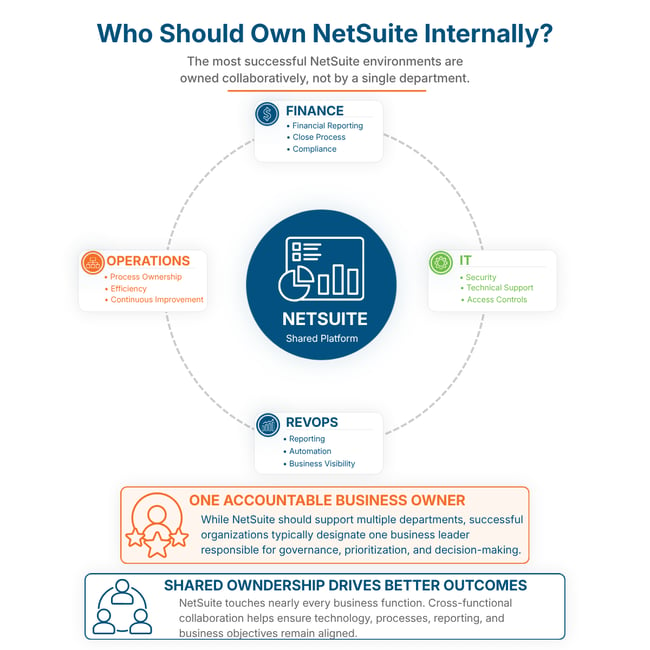
NetSuite ownership works best when a clearly defined primary owner — most often Finance for financially-focused implementations or Operations for operationally-complex ones — is supported by a cross-functional governance group representing all major system users. The right model depends on your organization's structure, your system's primary use cases, and what internal capabilities exist. Organizations that leave ownership undefined tend to experience stalled improvement work, inconsistent reporting, deteriorating security controls, and escalations that default to whoever holds the most organizational influence.
One of the most consequential decisions a NetSuite customer makes after go-live is also one of the least discussed: who owns the system internally? Not who uses it — most of the organization uses it — but who is accountable for how it is configured, how it evolves, what gets prioritized, and how it is governed over time.
This question does not have a universal answer. The right model depends on how the organization is structured, what the system is primarily used for, and what internal capabilities exist. But the wrong model — or no model at all — creates predictable, recurring problems that undermine the value of the system.
Why Ownership Matters
NetSuite is not a static system. It requires active management: configurations change, processes evolve, new features are released, integrations need maintenance, access controls require review, and the system must adapt as the business grows and changes. That ongoing management requires someone to be accountable for it.
When ownership is clearly defined, enhancement requests have a home. Decisions get made. The system improves over time. Users know who to escalate to and trust that escalations will be handled. The roadmap is maintained and communicated.
When ownership is unclear, none of those things happen reliably.
What Happens When Ownership Is Unclear
The consequences of unclear ERP ownership are predictable and well-documented in organizations that have lived through them:
- Enhancement requests stall: There is no clear owner to triage requests, no defined process for evaluation, and no accountability for moving items forward. Requests sit in email threads or spreadsheets for months without action.
- Reporting becomes inconsistent: Different departments run different reports and get different numbers. With no owner enforcing reporting standards, definitions drift and reconciliation becomes a recurring manual exercise.
- Support escalation becomes political: When there is no defined owner, escalations default to whoever has the most organizational influence. High-value requests from less visible departments go unaddressed while lower-value requests from influential stakeholders jump the queue.
- Security controls deteriorate: Access reviews require someone to own them. When ownership is unclear, reviews do not happen, access accumulates, and the organization accumulates segregation-of-duties violations that surface during audits.
- Releases are not managed: NetSuite releases twice per year. Without an owner, releases are not reviewed, new features are not evaluated, and the organization misses opportunities to adopt capabilities that could reduce manual work or improve reporting.
Finance Ownership
In many organizations, Finance is the natural candidate for NetSuite ownership. NetSuite is fundamentally a financial system — the general ledger, chart of accounts, period close process, and financial reporting all live there. Finance leadership is often the executive sponsor for the implementation and has the clearest stake in the system's performance.
Finance ownership works well when the organization primarily uses NetSuite for financial management, when the Finance team has sufficient technical capacity to manage configuration decisions and communicate them to IT, and when the CFO or Controller is willing to take on accountability for system management as a core responsibility.
Finance ownership struggles when the system is heavily used by Operations, Supply Chain, or other non-financial departments whose requirements do not always align with Finance priorities. It also struggles when Finance leadership treats NetSuite as a reporting tool rather than an operational system and delegates system management to junior staff who lack the authority to make cross-departmental decisions.
IT Ownership
IT ownership is common in organizations where NetSuite is managed as part of a broader technology portfolio. IT has the technical skills to manage integrations, custom scripting, release testing, and security controls — all of which are genuine components of ERP management.
Where IT ownership excels is the technical layer: integration management, access provisioning, security review, and release sandbox testing are all areas where IT expertise adds genuine value.
Where IT ownership struggles is business process. IT departments are typically organized around technical delivery, not business process design. When a Finance team needs a new report or an Operations team needs a workflow change, the IT-owned prioritization process often does not weight business impact effectively. Technical requests tend to get prioritized over business configuration requests, even when the business configuration requests represent higher organizational value.
IT ownership also struggles when business stakeholders do not view IT as a peer in operational decision-making. If Finance and Operations teams do not bring their NetSuite requirements to IT because they do not trust IT to represent their priorities, the ownership model is not working even if it looks functional on an org chart.
Operations Ownership
In companies where NetSuite is the operational backbone — managing inventory, order management, fulfillment, procurement, or project management — Operations ownership can be highly effective. Operations leaders often have the clearest view of how the system affects daily work, where friction exists, and what improvements would have the greatest impact on throughput and efficiency.
Operations ownership is ideal when the organization's most complex processes live in the operational modules rather than the financial ones, when the Operations leader has both business credibility and sufficient technical awareness to manage system decisions, and when Finance is well-represented in the governance structure even if it is not the primary owner.
What Operations ownership misses is financial rigor. ERP systems must support financial reporting, period close processes, and audit requirements with a level of precision that operational leaders do not always prioritize. An Operations owner who does not actively partner with Finance on reporting standards and compliance controls will create gaps in those areas over time.
RevOps Ownership
Revenue Operations ownership is increasingly common in organizations where the NetSuite- CRM integration is central to how the business operates. RevOps leaders often manage the handoff between sales, customer success, and finance — a handoff that in many organizations runs through NetSuite.
RevOps ownership works well for the integration layer and for the order-to-cash process, where RevOps leadership often has the deepest cross-functional visibility. It is a limited model for the rest of the system. RevOps is rarely positioned to own financial reporting standards, compliance controls, inventory management, or back-office operations with the same authority it brings to revenue cycle management.
In most organizations, RevOps is better positioned as a key stakeholder in a shared governance model than as the primary system owner.
The Best Model Is Shared Governance
For most organizations with moderate to high system complexity, the most effective ownership model is shared governance: a designated primary owner with clear accountability, supported by a cross-functional group with defined decision rights.
The primary owner is accountable for system health, the roadmap, change management, and governance process adherence. The cross-functional group ensures that decisions reflect the needs of all major system users, not just the department that happens to hold the primary ownership title.
This model does not eliminate hierarchy — the primary owner still has a tie-breaking role and is still accountable to leadership for system performance. But it distributes input and visibility in a way that produces better decisions and higher organizational trust.
How to Set Up Shared Governance
Standing up a shared governance model requires five steps:
- Step 1 — Identify the primary owner: Choose based on where the most critical business processes live and which leader has both the organizational authority and the willingness to take on ongoing accountability. Document the role and its responsibilities explicitly.
- Step 2 — Define group membership: The cross-functional governance group should include a named representative from each major department that uses the system — Finance, Operations, IT, Sales, Customer Service, and any other significant users. Representatives should have the authority to make commitments on behalf of their departments.
- Step 3 — Establish meeting cadence and decision process: Define how often the group meets, what it decides versus what it escalates, and how disagreements are resolved. Monthly operational meetings and quarterly roadmap reviews are a common cadence. Define the escalation path for decisions the group cannot resolve.
- Step 4 — Define the intake process: All enhancement requests, change requests, and new requirements should enter through a defined intake process. The process should include a standard intake form, evaluation criteria, and a defined timeline for response.
- Step 5 — Publish the model broadly: Every person in the organization who uses NetSuite should know who to contact with requests and questions, what the process is for submitting requests, and how decisions are made. Transparency is essential to building trust in the governance model.
What the Internal Owner Should Do
Regardless of which department holds primary ownership, the internal owner's responsibilities are consistent. A well-defined ownership role includes nine core responsibilities:
- Maintaining the NetSuite optimization roadmap and communicating it to stakeholders.
- Running or facilitating the intake and prioritization process for all system change requests.
- Owning the change management process and ensuring that changes are properly documented and tested before deployment.
- Coordinating with IT or managed services partners on technical implementation and release management.
- Conducting or commissioning periodic access reviews to ensure security controls are current.
- Reviewing NetSuite release notes before each release and making adoption decisions.
- Maintaining or overseeing the maintenance of system documentation.
- Serving as the primary escalation point for system issues that cannot be resolved at the department level.
- Reporting on system health, roadmap progress, and open issues to executive leadership on a defined cadence.
How to Transition Ownership If It Is in the Wrong Place Today
Many organizations recognize, months or years after go-live, that their current ownership model is not working. Transitioning ownership is possible but requires care to avoid disrupting ongoing system management.
Three steps support an effective transition:
- Document current state before transitioning: Before changing who owns the system, conduct a thorough documentation of current configurations, active customizations, open requests, and known issues. This documentation is the foundation the new owner needs to manage effectively from day one.
- Identify the new owner before completing the transition: Do not create a gap in ownership. The new owner should be named, briefed, and ready to take on responsibilities before the previous owner steps back. Overlap periods of two to four weeks — where both parties are actively engaged — smooth the handoff.
- Execute a formal handoff with managed services continuity: A managed services partner who has been supporting the system throughout can provide continuity during an ownership transition. Because the partner has documented system knowledge and defined processes, the transition does not require rebuilding institutional knowledge from scratch.
How Managed Services Support Internal Ownership
Managed services and internal ownership are complementary, not competitive. Internal ownership provides organizational authority, business context, and accountability. Managed services provide technical depth, process structure, and continuity.
The inVESTED PRO managed services program from The Vested Group is designed to support whatever internal ownership model the client uses. The program provides structured roadmap support, proactive system monitoring, change management process facilitation, documentation maintenance, and access to senior NetSuite expertise. Internal owners benefit from having a knowledgeable partner who handles the technical and process dimensions of system management while they focus on business alignment and organizational governance.
This model means that even organizations with limited internal NetSuite capacity can maintain effective ownership — because the managed services relationship fills the gaps without displacing internal accountability.
Frequently Asked Questions
Who should own NetSuite internally?
There is no universal answer, but the most effective primary owners tend to be the department where the most critical business processes live. Finance ownership works well when the system is primarily used for financial management and the Finance team has sufficient technical capacity. Operations ownership is effective when complex inventory, order management, or fulfillment processes dominate system usage. For most organizations with moderate to high complexity, the best model is shared governance: a primary owner with clear accountability supported by a cross-functional group.
What does a NetSuite system owner actually do?
The internal owner maintains the NetSuite optimization roadmap, runs the intake and prioritization process for all change requests, owns the change management process, coordinates with IT or managed services partners on technical implementation, conducts or commissions periodic access reviews, reviews NetSuite release notes before each release, maintains or oversees system documentation, serves as the primary escalation point for unresolved issues, and reports on system health and roadmap progress to executive leadership.
Should Finance or IT own NetSuite?
Finance ownership works best when the system is primarily used for financial management and the Finance team has technical capacity to manage configuration decisions. IT ownership excels in the technical layer — integration management, access provisioning, security review, and release sandbox testing — but often struggles with business process design and with earning trust from Finance and Operations stakeholders who do not view IT as a peer in operational decisions. In most organizations, the answer is a shared model rather than exclusive ownership by either department.
What is a NetSuite steering committee and does our organization need one?
A NetSuite steering committee is a cross-functional governance group that includes a named representative from each major department that uses the system. It meets on a defined cadence — typically monthly for operational triage — to review priorities, evaluate change requests, and ensure that system decisions reflect enterprise-wide needs rather than a single department's perspective. Most organizations with more than one major department heavily using NetSuite benefit from a steering committee structure; without it, prioritization defaults to the loudest voice or the most political department.
What happens when NetSuite ownership is unclear or undefined?
Unclear ownership produces predictable consequences: enhancement requests stall because there is no defined owner to triage them, reporting becomes inconsistent as different departments use different definitions without an owner enforcing standards, security controls deteriorate because access reviews require ownership to happen, and releases are not managed because no one is accountable for reviewing new features. Unclear ownership is not a stable state — it tends to be resolved informally by whoever ends up holding the most tickets or the most organizational influence.
How do we transition NetSuite ownership if the current model is not working?
Three steps support an effective ownership transition: document the current state thoroughly before changing who owns the system, including configurations, active customizations, open requests, and known issues; name and brief the new owner before completing the transition to avoid a gap in accountability; and execute a formal handoff with managed services continuity so that the partner team can provide knowledge bridge during the transition period. Do not change ownership during a period of heavy system activity such as a major release cycle or financial close.
How does managed services work alongside internal NetSuite ownership?
Managed services and internal ownership are complementary, not competitive. Internal ownership provides organizational authority, business context, and accountability that an external partner cannot replicate. Managed services provide technical depth, NetSuite platform expertise, and execution capacity that most internal teams cannot maintain cost-effectively on their own. inVESTED PRO from The Vested Group is designed to support whatever internal ownership model the client uses — providing structured roadmap support, proactive monitoring, and senior expertise without displacing the internal owner's authority or visibility.
Define Ownership Before It Defines You
Unclear ERP ownership is not a stable state. Organizations that do not define ownership deliberately tend to have it defined for them — by whoever ends up holding the most tickets, fielding the most complaints, or taking the most blame when something breaks. That is not an ownership model; it is an accident.
The organizations that get the most from NetSuite are those that make deliberate decisions about how the system will be owned and governed — and then sustain those decisions over time. If your organization is ready to define or refine its NetSuite ownership model, The Vested Group is ready to help. Contact us to learn how inVESTED PRO can support your internal ownership structure and keep your system performing at its best.

Candice Harris
Candice Harris is a Senior Consultant at The Vested Group with more than 20 years of accounting and financial leadership experience. As a former controller and NetSuite end user, she helps organizations optimize financial operations through practical, real-world ERP solutions. Candice specializes in financial management, Procure to Pay (P2P), Order to Cash (O2C), Record to Report (R2R), inventory management, advanced revenue management, intercompany accounting, and Avalara integrations, helping clients maximize the value of their NetSuite investment.