.png "The Vested Group | NetSuite Solution Provider Partner | NetSuite Consulting | NetSuite Support")
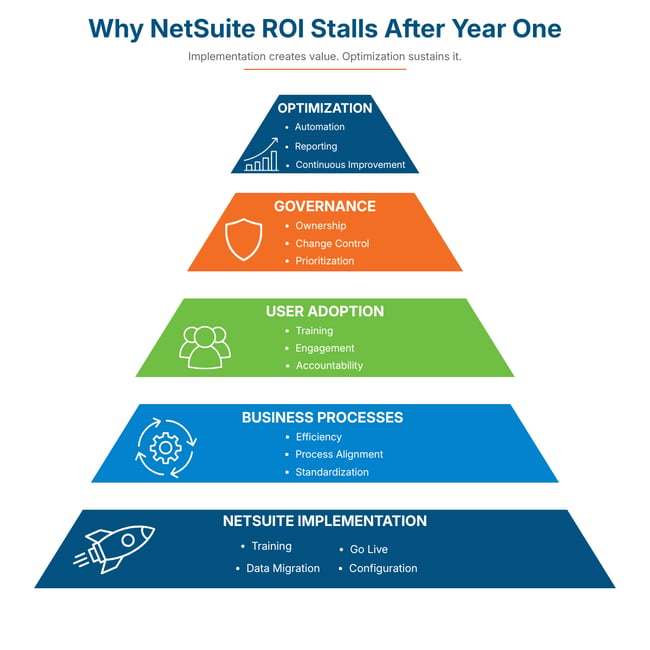
NetSuite ROI stalls after year one because sustaining and growing ERP value requires ongoing investment in system optimization, reporting development, and process alignment — and most organizations reduce that investment once the initial implementation is complete. The first year delivers structural gains from replacing legacy systems and establishing a single source of financial truth; maintaining and expanding those gains requires a continuous improvement program that most internal teams are not resourced to sustain on their own. Organizations that treat go-live as the finish line find that manual work creeps back in, reporting confidence declines, and the ERP gradually falls out of alignment with the business it was implemented to serve.
The first year of a NetSuite implementation is typically defined by momentum. Teams complete the implementation, go live, and begin realizing the efficiency gains that justified the investment. Processes that once relied on spreadsheets and manual entry are automated. Reporting becomes faster. Visibility across the organization improves. Leadership declares the project a success.
Then year two begins. And the improvements slow down.
This pattern is not unique to any single organization or industry. It is a structural reality of enterprise resource planning adoption. The systems that deliver dramatic early results require continuous investment, governance, and improvement to sustain those results over time. Without that sustained effort, ROI does not simply plateau — it actively erodes.
Understanding why NetSuite ROI stalls — and what organizations can do about it — is essential for any finance or operations leader responsible for justifying and protecting that investment.
How to Measure Whether ROI Has Stalled
Before diagnosing the cause of stalled ROI, it is important to establish whether ROI has actually stalled. Many organizations lack the metrics infrastructure to answer this question with confidence. The following five operational indicators, tracked quarterly, provide a reliable baseline for evaluating ERP performance over time.
- Financial close cycle duration. If the number of days required to close the books is increasing, or has not decreased despite the promise of automation, the ERP is not delivering expected efficiency. A close cycle that remains flat or grows longer year over year is a direct indicator of underperformance.
- Manual workaround volume. Teams that have developed workarounds — using spreadsheets, email threads, or external tools to compensate for ERP limitations — are signaling that the system is not serving their needs. Tracking the number and nature of known workarounds provides a proxy measure of adoption and configuration health.
- Support ticket volume and resolution time. Rising support demand, particularly for the same recurring issues, indicates that the system is not being maintained or improved. Long resolution times signal that the support model is reactive rather than proactive.
- Report and dashboard usage rates. If users are not accessing native NetSuite reports and are instead building ad hoc exports or relying on external tools for analysis, reporting confidence has declined. This reduces the value of the data the system contains.
- License utilization relative to active users. A gap between purchased licenses and active users suggests adoption has declined. Low adoption means the investment is not being fully leveraged across the organization.
Tracking these five indicators quarterly creates the evidence base required to identify stagnation early — before it compounds into structural underperformance.
Why Year One Momentum Fades
Year one ROI is largely implementation ROI. The gains are structural: replacing legacy systems, eliminating manual processes, and establishing a single source of financial truth. These gains are real, but they are one-time. Once the baseline is established, continuing to generate ROI requires a different kind of effort — ongoing improvement ROI.
Ongoing improvement ROI comes from optimizing the system as business processes evolve, expanding adoption across departments, leveraging new features and modules, and refining reporting to reflect how the business actually measures performance. This work is continuous, not episodic. It requires dedicated expertise, organizational prioritization, and a feedback loop between users and administrators.
Most organizations do not build this infrastructure. They complete the implementation, reduce their internal investment in the system, and assume the ERP will continue to deliver value on its own. It will not.
Why Manual Work Creeps Back In
One of the clearest signs of stalled ROI is the return of manual work. This happens gradually and often without formal acknowledgment. A reporting requirement arises that the system does not address cleanly. A user finds it faster to export data and manipulate it in a spreadsheet than to build a saved search. A process changes and no one updates the corresponding workflow in NetSuite.
Each individual workaround seems reasonable in isolation. Collectively, they represent a retreat from the system. Over time, the organization develops a parallel infrastructure of spreadsheets, manual reconciliations, and shadow processes that exist alongside NetSuite rather than within it. The ERP becomes one input among many rather than the authoritative system of record it was designed to be.
Manual work creeping back in is not a user behavior problem. It is a system maintenance problem. It signals that the ERP has not kept pace with the organization's needs.
Reporting Needs Mature Faster Than the System
In year one, the reporting available through NetSuite represents a significant improvement over what the organization had before. Standard financial reports, consolidated views, and basic dashboards are sufficient for most early use cases.
By year two and three, leadership expectations evolve. They want dimensional analysis by product line, department, or geography. They want operational metrics alongside financial data. They want reports that reflect the way the business has grown and changed since go-live. If the NetSuite environment has not been updated to reflect these needs — through new saved searches, custom fields, updated dashboards, and refined data structures — reporting confidence declines.
When leaders cannot get the data they need from the system, they stop relying on it. Decisions get made based on incomplete information, external analyses, or management intuition rather than the ERP data the organization is paying to maintain.
Processes Change Faster Than the System
Businesses are not static. Revenue models change. New product lines are added. Acquisitions occur. Regulatory requirements shift. Each of these changes creates new demands on the ERP — new fields, new workflows, new approval structures, new reporting dimensions.
When these changes are not reflected in NetSuite, the system falls out of alignment with the business it is supposed to support. Users experience this misalignment as friction: processes that do not match how work actually gets done, approval workflows that route incorrectly, fields that do not capture the data that matters.
Over time, this friction reduces adoption. Users stop trusting the system. They develop workarounds. And the gap between the ERP and the business it serves continues to widen.
Support Becomes Reactive
Many organizations transition to a reactive support model after go-live. Issues are addressed when they are reported. Maintenance occurs when something breaks. There is no proactive assessment of configuration health, no regular review of system performance, and no mechanism for translating user feedback into system improvements.
Reactive support is insufficient for protecting ERP investment. It allows problems to accumulate until they become critical. It fails to anticipate the impact of business changes on system performance. And it creates a support experience that reinforces user distrust rather than rebuilding confidence.
Real Indicators That the ERP Is Underperforming Financially
Beyond operational metrics, there are direct financial signals that indicate the ERP is not delivering expected value:
- Delayed financial close. A close cycle that extends beyond five to seven business days typically indicates manual reconciliation steps that should be automated, data quality issues requiring remediation before reporting, or workflow gaps that slow the review and approval process.
- Audit overhead. If audit preparation requires significant manual effort to compile documentation, reconcile records, or explain discrepancies, the ERP is not maintaining the audit trail it should. This overhead represents both direct cost and compliance risk.
- High support cost per issue. When each support ticket requires significant investigation and resolution time, it signals that issues are complex, recurring, or systemic — all of which indicate underlying configuration problems rather than isolated incidents.
- Duplicate tooling costs. Organizations that are paying for external tools — business intelligence platforms, project management software, revenue recognition solutions — to compensate for NetSuite limitations are paying twice for functionality that should exist within the ERP.
- Revenue recognition delays. Delays in recognizing revenue, particularly in subscription or project-based businesses, often trace back to ERP configuration issues, data quality problems, or workflow gaps in the billing and recognition process.
The Compounding Cost of Stagnation: Years Two Through Five
The financial impact of ERP stagnation compounds over time. Year two is typically manageable. The organization still benefits from the structural improvements of year one, and the gap between the system and the business has not yet grown wide enough to cause serious disruption. Leadership may not even recognize that stagnation has begun.
By year three, configuration drift becomes visible. Workarounds have accumulated. Reporting confidence has declined. The ERP team — often reduced after go-live — is spending most of its time on reactive support rather than improvement. The system that was designed to enable growth is beginning to constrain it.
Years four and five often reveal structural limitations that result directly from decisions made (or deferred) in years two and three. Customizations built to compensate for unaddressed gaps create upgrade risk. Data structures that were not refined as the business grew make reporting increasingly difficult. The cost of remediating these issues grows as the organization's dependence on the workarounds and compensating structures increases.
What Happens to NetSuite Environments Left Without Continuous Improvement
Environments that do not receive ongoing investment follow a predictable degradation pattern:
- Configuration drift. The environment gradually diverges from best practices as quick fixes accumulate and no one reviews the overall architecture. What begins as a pragmatic solution to an immediate problem becomes a permanent constraint.
- Workaround entrenchment. Workarounds that were intended to be temporary become institutionalized. New employees are trained to use them. They are documented as standard procedure. Removing them becomes increasingly difficult because the organization has built processes around them.
- Documentation degradation. System documentation, if it exists at all, becomes outdated as the environment evolves. When key administrators leave, institutional knowledge walks out with them. The organization loses the ability to understand its own system.
- Adoption decline. As friction increases and reporting confidence declines, users disengage from the system. New employees observe experienced colleagues using workarounds and replicate the behavior. Adoption falls below the level required to justify the investment.
How to Keep ROI Moving: Seven Actions
Organizations that sustain ERP ROI over time share common practices. The following seven actions represent the foundation of an ongoing improvement program:
- Establish a quarterly review cadence. Review the five operational indicators described above on a quarterly basis. Use the data to identify trends and prioritize improvement efforts.
- Maintain a continuous improvement backlog. Capture user feedback, reported issues, and enhancement requests in a structured backlog. Prioritize items based on business impact and implementation complexity.
- Align the ERP roadmap with the business roadmap. Ensure that system administrators are aware of planned business changes — new product lines, acquisitions, regulatory changes — far enough in advance to prepare the system.
- Invest in reporting infrastructure. Regularly review and update saved searches, custom reports, and dashboards to ensure they reflect current business needs and leadership priorities.
- Address workarounds systematically. Conduct periodic audits of known workarounds. For each, determine whether it can be eliminated through configuration improvement and prioritize accordingly.
- Monitor adoption metrics. Track login frequency, feature usage, and support ticket patterns to identify departments or user groups where adoption has declined. Investigate root causes before deploying additional training.
- Stay current with NetSuite releases. NetSuite releases updates twice per year. Organizations that proactively evaluate and adopt relevant new features maintain a higher return on their subscription investment.
How to Reignite ROI Momentum
For organizations that have already experienced stagnation, reigniting momentum requires a structured approach rather than a series of disconnected fixes.
The process begins with an environment audit: a comprehensive assessment of the current state of the NetSuite environment, including configuration health, customization inventory, reporting quality, integration performance, and adoption patterns. The audit establishes a clear picture of where the environment stands relative to where it should be.
From the audit, a prioritized roadmap is developed. Not every issue can or should be addressed simultaneously. The roadmap sequences improvements based on business impact, dependency relationships, and implementation complexity. It provides a clear structure for the improvement effort and a mechanism for communicating progress to leadership.
The roadmap is then executed within a sustained improvement structure: a defined cadence of review, planning, implementation, and validation that keeps the improvement effort moving forward rather than stalling after the first wave of fixes.
The Role of Managed Services in Protecting Long-Term ERP Value
Sustaining NetSuite ROI requires a level of expertise and organizational commitment that most internal teams cannot maintain on their own. The skills required — system architecture, SuiteScript development, SuiteFlow configuration, reporting design, integration management — span multiple disciplines. The workload is continuous, not episodic.
This is where managed services provide a structural advantage. A managed services relationship provides access to the full range of NetSuite expertise without the cost of building an internal team with equivalent depth. It establishes the proactive improvement cadence that reactive support models cannot deliver. And it creates institutional continuity that protects against the knowledge loss that occurs when internal administrators leave.
The inVESTED PRO managed services program from The Vested Group is built specifically around this challenge. Rather than functioning as a break-fix support desk, inVESTED PRO operates as an ongoing strategic partnership — assessing the environment, maintaining the improvement roadmap, executing enhancements, and monitoring system health on a continuous basis. The goal is not to respond to problems after they occur. It is to prevent them from occurring while keeping the ERP aligned with the business it supports.
Organizations that treat their NetSuite investment as complete at go-live will find that ROI declines over time. Organizations that treat it as the beginning of an ongoing program will find that the system continues to deliver increasing value as the business grows and evolves.
Client Spotlight
AI Inside NetSuite: Real Implementations Across Eight Companies
While many organizations treat AI in ERP as a future consideration, a growing number of companies have already deployed AI-powered capabilities directly inside NetSuite. These implementations span professional services, insurance, cloud technology, and marketing — covering use cases from automated bank reconciliation and intelligent chart of accounts restructuring to real-time AI connectors that move data between systems without manual intervention.
Across these engagements, the consistent finding is that practical AI implementation in NetSuite requires both technical integration expertise and business process clarity. Organizations that invest in structured onboarding — including on-site training and well-defined automation scope — see significantly stronger adoption and measurable reduction in manual processing time. AI in NetSuite is not a roadmap item. For these companies, it is already operational.
Industries: Professional Services, Insurance, SaaS, Marketing | Outcome: AI-powered automation deployed across finance and operations workflows
Frequently Asked Questions
Why does NetSuite ROI decline after the first year?
Year one ROI is largely structural — it comes from replacing legacy systems, eliminating manual processes, and establishing a single source of financial truth. These gains are realized at go-live and do not require ongoing effort to maintain. Ongoing improvement ROI requires a different kind of investment: optimizing the system as business processes evolve, expanding adoption, leveraging new features and modules, and refining reporting. Most organizations reduce their internal ERP investment after go-live and do not build the infrastructure necessary to sustain ongoing improvement.
How do I know if my NetSuite ROI has stalled?
Five indicators reveal stagnation: financial close cycle duration (if it is increasing or has not improved since go-live), manual workaround volume (if teams are using spreadsheets or email threads to compensate for ERP limitations), support ticket volume and resolution time (if rising or if the same issues recur), report and dashboard usage rates (if users are not accessing native NetSuite reports), and license utilization relative to active users (if a significant gap has developed between purchased licenses and active users). Tracking these quarterly creates the evidence base to identify stagnation before it compounds.
What causes manual work to come back after NetSuite implementation?
Manual work returns because the ERP does not keep pace with the organization's evolving needs. A reporting requirement arises that the system does not address, so someone builds a spreadsheet. A process changes and the workflow is not updated, so users find a workaround. Each individual workaround seems reasonable in isolation, but collectively they represent a retreat from the system. Manual work creeping back is not a user behavior problem — it is a system maintenance problem that signals the ERP has fallen out of alignment with how the business actually operates.
What is the financial impact of leaving NetSuite without continuous improvement?
Direct financial signals include a delayed financial close cycle that indicates unautomated reconciliation steps, elevated audit overhead from manual documentation and reconciliation processes, high support cost per issue from complex or recurring tickets, duplicate tooling costs from paying for external tools that compensate for ERP gaps, and revenue recognition delays that trace to configuration issues or data quality problems. Beyond these direct costs, the compounding effect of configuration drift, workaround entrenchment, and adoption decline means that years three through five often reveal structural limitations that result directly from deferred investment in years two and three.
How do we reignite ROI momentum in a stalled NetSuite environment?
Reigniting momentum requires a structured approach rather than a series of disconnected fixes. The process begins with an environment audit — a comprehensive assessment of configuration health, customization inventory, reporting quality, and workaround accumulation. From the audit, a prioritized roadmap is developed that sequences improvements by business impact and dependency relationships. The roadmap is then executed within a sustained improvement structure with a defined cadence of review, planning, implementation, and validation. Without this structure, individual fixes provide temporary relief without addressing the underlying pattern of deferred investment.
What seven actions help sustain NetSuite ROI over time?
The seven foundation actions are: establishing a quarterly review cadence to track the five operational indicators, maintaining a continuous improvement backlog with structured prioritization, aligning the ERP roadmap with the business roadmap so system administrators are aware of planned business changes, investing regularly in reporting infrastructure, auditing known workarounds periodically to eliminate them through configuration improvement, monitoring adoption metrics by department and user group, and staying current with NetSuite's twice-annual releases to evaluate and adopt relevant new features.
How does managed services help protect long-term NetSuite ROI?
Sustaining NetSuite ROI requires a combination of skills — system architecture, SuiteScript development, functional process design, reporting expertise — that fluctuates in most internal teams due to turnover, competing priorities, and budget constraints. A managed services relationship provides access to the full range of NetSuite expertise on a consistent basis without the cost of building an internal team at that depth. inVESTED PRO from The Vested Group is built specifically around this challenge: rather than functioning as a break-fix support desk, it operates as an ongoing improvement program with structured roadmap reviews, proactive monitoring, and continuous optimization as core deliverables.
The Choice Is Not Whether to Invest — It Is How
Every NetSuite customer makes a choice about how to sustain their investment. Some choose to rely on internal resources, accepting the limitations that come with fluctuating capacity and turnover. Some choose reactive support, addressing problems as they arise. And some choose a proactive managed services model that treats continuous improvement as a core component of the ERP strategy.
The organizations that generate the strongest long-term ROI from NetSuite are those that make the third choice — and make it deliberately, before stagnation has already taken hold.
If your organization is experiencing any of the stagnation indicators described in this post, or if you are approaching the transition from year one to year two and want to establish the right foundation, contact The Vested Group to learn how inVESTED PRO can protect and grow your NetSuite investment over time.

Joseph Lang
Joseph Lang is the Director of inVESTED PRO at The Vested Group. With more than 13 years of NetSuite experience, he helps organizations maximize the value of their ERP investment through strategic guidance, operational improvements, and ongoing managed services. Joseph specializes in NetSuite optimization, manufacturing, warehouse management, inventory management, procurement, and SuiteCommerce, helping clients continuously improve their business processes and long-term ERP performance.