.png "The Vested Group | NetSuite Solution Provider Partner | NetSuite Consulting | NetSuite Support")
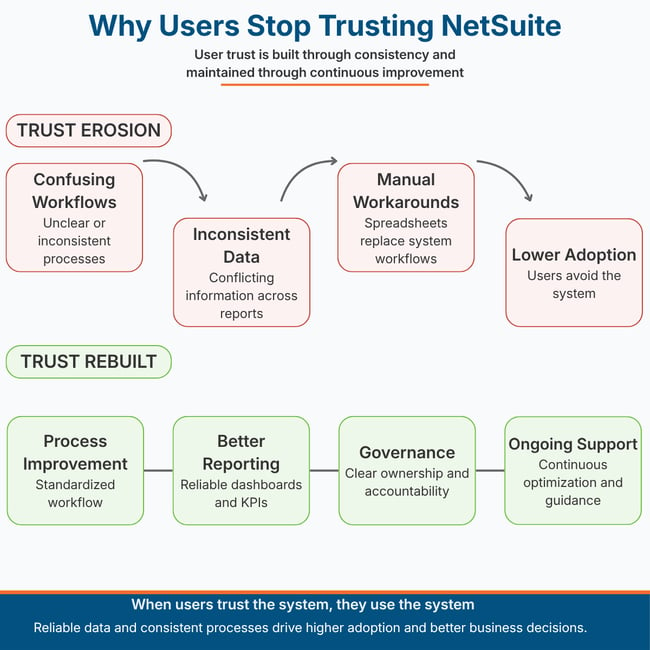
NetSuite users stop trusting the ERP system when the data it contains no longer reflects the reality they experience in their daily work — when reports require manual validation before anyone will act on them, when workflows create friction instead of eliminating it, and when the same issues recur without resolution. Trust erosion is rarely sudden; it accumulates through repeated friction, unresolved problems, and workarounds that gradually replace the system itself. Restoring trust requires addressing root causes — data quality, workflow alignment, and reporting accuracy — not simply retraining users or issuing directives to stop using spreadsheets.
Enterprise resource planning systems are purchased on the promise of a single source of truth. When the implementation goes well, that promise is fulfilled: financial data is reliable, processes are consistent, and the organization makes decisions based on information it trusts.
But trust in an ERP system is not permanent. It is earned continuously — through accurate data, responsive workflows, and a system that reflects how the business actually operates. When those conditions are not maintained, trust erodes. And when users stop trusting the system, they stop using it in the ways it was designed to be used.
This erosion is one of the most consequential and least-discussed challenges in NetSuite management. It is not a technology failure in the traditional sense — the system continues to run, data continues to flow, and reports continue to generate. But the organization's relationship with its own ERP has fundamentally broken down.
How to Measure User Trust: Six Leading Indicators
Unlike system uptime or processing speed, user trust is not directly observable. It must be inferred from behavioral signals. The following six leading indicators provide a reliable picture of trust levels across the organization:
- Workaround volume. The number of known workarounds — spreadsheets, manual processes, external tools used in place of NetSuite functionality — is a direct measure of how often users have concluded that the system cannot be relied upon to meet their needs. Each workaround represents a point where trust failed.
- Report validation requests. When users regularly ask colleagues to verify the accuracy of system-generated reports before presenting them, it signals that they do not trust the data the ERP is producing. This behavior is particularly common in organizations where data quality issues have occurred in the past.
- Login frequency relative to expected usage. A decline in login frequency among user groups that should be regular system users indicates disengagement. When users find that logging into NetSuite creates more friction than it resolves, they reduce their usage.
- Support ticket language. The way users describe support issues reveals their emotional relationship with the system. Tickets that express frustration with recurring problems, that reference previous unresolved issues, or that include phrases like "this keeps happening" indicate eroding confidence rather than isolated technical problems.
- Meeting references to the system. In organizations with high ERP trust, users reference system data in meetings as authoritative. In organizations with low trust, users preface data with qualifiers — "according to NetSuite, but I am not sure this is right" — or avoid referencing system data altogether.
- Onboarding friction for new users. When experienced users train new colleagues to use workarounds as part of standard onboarding, trust issues have become institutionalized. The organization is formally transmitting distrust to its newest members.
Trust Declines Gradually — Through Repeated Friction
User trust in an ERP system does not fail suddenly. It declines through accumulation. Each instance of incorrect data, each workflow that does not function as expected, each report that requires manual correction before it can be used adds a small increment to the trust deficit.
Individual users rarely make a conscious decision to stop trusting the system. The shift happens below the level of explicit awareness. They begin double-checking data as a matter of habit. They start maintaining their own records as a backup. They discover that colleagues have developed workarounds and adopt them without questioning whether a better option exists in the system.
By the time the trust deficit becomes visible to leadership — through adoption metrics, support volumes, or user complaints — it has typically been developing for months or years. The challenge is not reversing a sudden event. It is unwinding a pattern of accumulated experience.
Workarounds Are a Trust Signal
It is tempting to view workarounds as a user behavior problem — as evidence that employees are resistant to change or unwilling to learn the system properly. This framing misdiagnoses the problem and leads to interventions that do not work.
Workarounds are rational responses to system limitations. When a user discovers that completing a task through NetSuite produces incorrect results, requires excessive manual steps, or fails to capture information the business needs, creating a workaround is the pragmatic solution. The workaround is not the problem — it is the symptom of a system that has not kept pace with user needs.
Treating workarounds as a trust signal rather than a compliance failure changes the organizational response. Instead of instructing users to stop using workarounds, the appropriate response is to investigate what the workaround is compensating for and address that underlying gap.
Reporting Confidence Matters Most
Of all the trust dimensions in an ERP system, reporting confidence has the highest organizational impact. Users can tolerate workflow inefficiencies. They can adapt to process friction. But when they cannot trust the data the system produces, the entire value proposition of the ERP is compromised.
Reporting confidence declines when data entry inconsistencies make aggregations unreliable, when custom fields are not consistently populated, when saved searches do not reflect current business logic, or when the chart of accounts does not align with how the business reports performance. These are not user errors — they are system configuration and governance problems.
The consequence of low reporting confidence extends far beyond the ERP itself. When leaders cannot rely on NetSuite data, they commission external analyses, build parallel reporting infrastructure, or make decisions based on incomplete information. The cost of this parallel infrastructure — in time, tooling, and decision quality — often exceeds the cost of remedying the underlying system issues.
Process Friction Reduces Adoption
Every unnecessary step in a NetSuite workflow is a tax on user adoption. When completing a standard transaction requires navigating through screens designed for a different version of the process, entering data in fields that do not reflect current business terminology, or obtaining approvals through workflows that no longer match the organization's structure, users experience the system as an obstacle rather than an enabler.
Process friction accumulates in the same way that trust deficits do — gradually, through repeated experience. Users who find a faster path outside the system will take it. And the longer that path remains available, the more embedded it becomes in organizational behavior.
Why Training Alone Does Not Rebuild Trust
The instinctive organizational response to adoption decline and user frustration is additional training. This response reflects a misdiagnosis of the problem.
Training addresses a knowledge gap: users do not know how to use the system correctly. Retraining can be effective when this is the actual problem — when users are using the system incorrectly because they were not adequately trained in the first place.
But when trust has eroded due to data quality issues, workflow misalignment, or reporting failures, the problem is a confidence gap — users know how to use the system, but they have concluded through experience that doing so produces unreliable results. Retraining does not address this conclusion. It may even reinforce distrust if users complete the training and then return to a system that still behaves the way that caused them to lose confidence.
Rebuilding trust requires fixing the underlying issues — and then communicating those fixes to users. The communication component is as important as the technical remediation. Users who are not informed that specific issues have been resolved will continue to apply the avoidance behaviors they developed in response to those issues, even after the issues no longer exist.
The Organizational Cost of an ERP That Employees Do Not Trust
The costs of low ERP trust extend well beyond the immediate inefficiency of workarounds.
The direct time cost is measurable: every hour a user spends maintaining a parallel spreadsheet, validating system-generated data, or completing a manual process that should be automated is an hour not spent on higher-value work. Across a user base of dozens or hundreds of employees, this aggregate cost is substantial.
The indirect costs are often larger:
- Decision latency. When data requires validation before it can be used, decisions take longer. In fast-moving business environments, this latency has direct operational consequences.
- Error rates. Manual processes and workarounds introduce error rates that automated system processes do not. Data entry errors, reconciliation mistakes, and version control failures in parallel spreadsheets all represent downstream risk.
- Compliance exposure. Organizations that do not rely on their ERP as the authoritative system of record face increased audit risk. When auditors ask for documentation and the response involves compiling data from multiple sources, the exposure is real.
- Cultural cost. Perhaps most significantly, low ERP trust damages the organization's broader relationship with its technology investments. When employees learn that expensive enterprise software does not deliver on its promises, it becomes harder to build organizational commitment to future technology initiatives.
A Practical Framework for Diagnosing Root Causes
Before trust can be rebuilt, root causes must be identified. The following four-category framework provides a structured approach to diagnosis:
- Data integrity issues. Are there known data quality problems — duplicate records, inconsistent field usage, unmapped transaction types — that make system-generated reports unreliable? Data integrity issues are often the single largest driver of reporting confidence decline.
- Workflow and process misalignment. Have business processes changed in ways that are not reflected in NetSuite workflows? Are approval chains outdated? Are transaction forms collecting the wrong information or missing required fields? Process misalignment creates friction and drives workaround adoption.
- Reporting gaps. Does the current report library reflect what leadership and operational managers actually need to see? Are saved searches structured to support current business logic? Reporting gaps drive users to external tools and reduce system engagement.
- Support and responsiveness failures. When users report issues, are those issues addressed promptly and effectively? A support model that is slow, inconsistent, or focused on workarounds rather than fixes reinforces the belief that the system cannot be relied upon.
How Companies Rebuild Trust: Seven Actions
Rebuilding ERP trust is a structured effort, not a single intervention. The following seven actions, executed in sequence, provide a reliable path from distrust to adoption:
- Conduct a comprehensive environment assessment. Before making changes, establish a clear picture of the current state: configuration health, data quality, workflow alignment, reporting coverage, and adoption patterns.
- Address data quality issues first. Data integrity is the foundation of reporting confidence. Clean data before improving reporting, or the improved reporting will simply surface the same underlying problems.
- Update workflows to reflect current processes. Review approval chains, transaction forms, and automated workflows against current business processes. Update anything that no longer reflects how work actually gets done.
- Rebuild the report library. Audit existing saved searches and custom reports. Retire those that are no longer relevant. Build the reports and dashboards that leadership and operational users actually need.
- Eliminate or remediate the highest-impact workarounds. Identify the workarounds that have the broadest adoption or the highest risk exposure. Address the underlying gaps that created them and communicate the resolution to affected users.
- Establish a responsive support channel. Users need to know that when they report an issue, it will be addressed. A clear, responsive support channel is essential to demonstrating that the organization is committed to maintaining the system.
- Communicate improvements explicitly. Do not assume that users will notice or internalize system improvements on their own. Communicate what was fixed, why it was fixed, and what users can now expect from the system. This communication is essential to closing the confidence gap.
Frequently Asked Questions
Why do NetSuite users lose trust in the ERP system?
Users lose trust when the data in NetSuite no longer matches what they experience in their day-to-day work — when reports require manual verification, workflows produce incorrect results, or the system does not reflect current business processes. Each unresolved issue adds to a deficit of confidence that accumulates gradually until users treat the system as unreliable by default.
What are the most common warning signs of declining ERP trust?
The most reliable indicators are an increase in spreadsheet workarounds, users regularly asking colleagues to validate report data before using it, declining system login frequency, and support tickets written with frustrated or skeptical language. When new employees are trained to use workarounds as part of standard onboarding, the trust deficit has reached a critical level.
Can ERP user trust be rebuilt after it has eroded?
Trust can be rebuilt, but it requires fixing the underlying issues — data quality, workflow alignment, reporting accuracy — rather than simply retraining users. Rebuilding trust also requires communicating improvements explicitly to users, because those who have learned to distrust the system will not notice or internalize changes on their own.
How long does it take to rebuild user trust in NetSuite?
Organizations that engage a structured managed services program and address data quality, workflow alignment, and reporting governance in sequence typically see measurable improvement in user behavior within three to six months, with more durable trust restored over a twelve-month improvement program. The timeline depends on the depth of the underlying issues and the resources available to address them.
What is the organizational cost of low ERP trust?
Low ERP trust creates direct costs through duplicate labor — manual workarounds and spreadsheet maintenance — decision latency, and elevated error rates. The indirect costs — compliance exposure, cultural damage to the organization's relationship with its technology investment, and employee frustration — are often larger than the direct costs and harder to recover from.
Does user retraining resolve ERP trust issues?
Retraining addresses a knowledge gap — users do not know how to use the system — but does not fix a confidence gap — users know how to use it but have stopped trusting it. When trust has eroded due to data quality problems, workflow failures, or reporting inaccuracies, the system itself must be corrected before retraining can be effective.
How does a managed services engagement help rebuild NetSuite user trust?
A managed services partner provides the expertise and sustained capacity required to address the root causes of trust erosion — resolving data quality issues, updating workflows to reflect current processes, rebuilding the report library, and eliminating high-impact workarounds. The inVESTED PRO program from The Vested Group is built around this model, delivering continuous environmental improvement rather than reactive break-fix support.
How Managed Services Systematically Rebuild ERP Credibility
Rebuilding ERP trust is not a one-time project. It requires the same sustained investment that allowed trust to erode in the first place — but directed toward improvement rather than maintenance.
A structured managed services engagement provides the expertise, capacity, and continuity required to execute this effort effectively. The process begins with an environment and adoption assessment that identifies the specific root causes of trust decline in the organization's NetSuite environment. From this assessment, a prioritized remediation roadmap is developed — addressing data quality, workflow alignment, and reporting gaps in a sequence that delivers visible improvements quickly while building toward structural stability.
Ongoing check-ins between the managed services team and organizational stakeholders create the feedback loop required to keep the improvement effort aligned with user experience. Users who previously lost trust in the system need to see consistent, reliable improvement over time — not a burst of activity followed by a return to reactive support.
The inVESTED PRO program from The Vested Group is built around this model. Rather than functioning as a break-fix support desk, inVESTED PRO provides a structured partnership that combines proactive environment management, continuous improvement execution, and regular stakeholder communication. The goal is not simply to fix what is broken — it is to systematically rebuild the credibility of the ERP as an organizational asset that employees can rely on.
If your organization is experiencing the signs of declining user trust — workarounds, reporting concerns, adoption decline, or support frustration — the path forward begins with an honest assessment of root causes. Contact The Vested Group to learn how inVESTED PRO can help restore confidence in your NetSuite investment and build the foundation for sustained adoption and value.

Candice Harris
Candice Harris is a Senior Consultant at The Vested Group with more than 20 years of accounting and financial leadership experience. As a former controller and NetSuite end user, she helps organizations optimize financial operations through practical, real-world ERP solutions. Candice specializes in financial management, Procure to Pay (P2P), Order to Cash (O2C), Record to Report (R2R), inventory management, advanced revenue management, intercompany accounting, and Avalara integrations, helping clients maximize the value of their NetSuite investment.